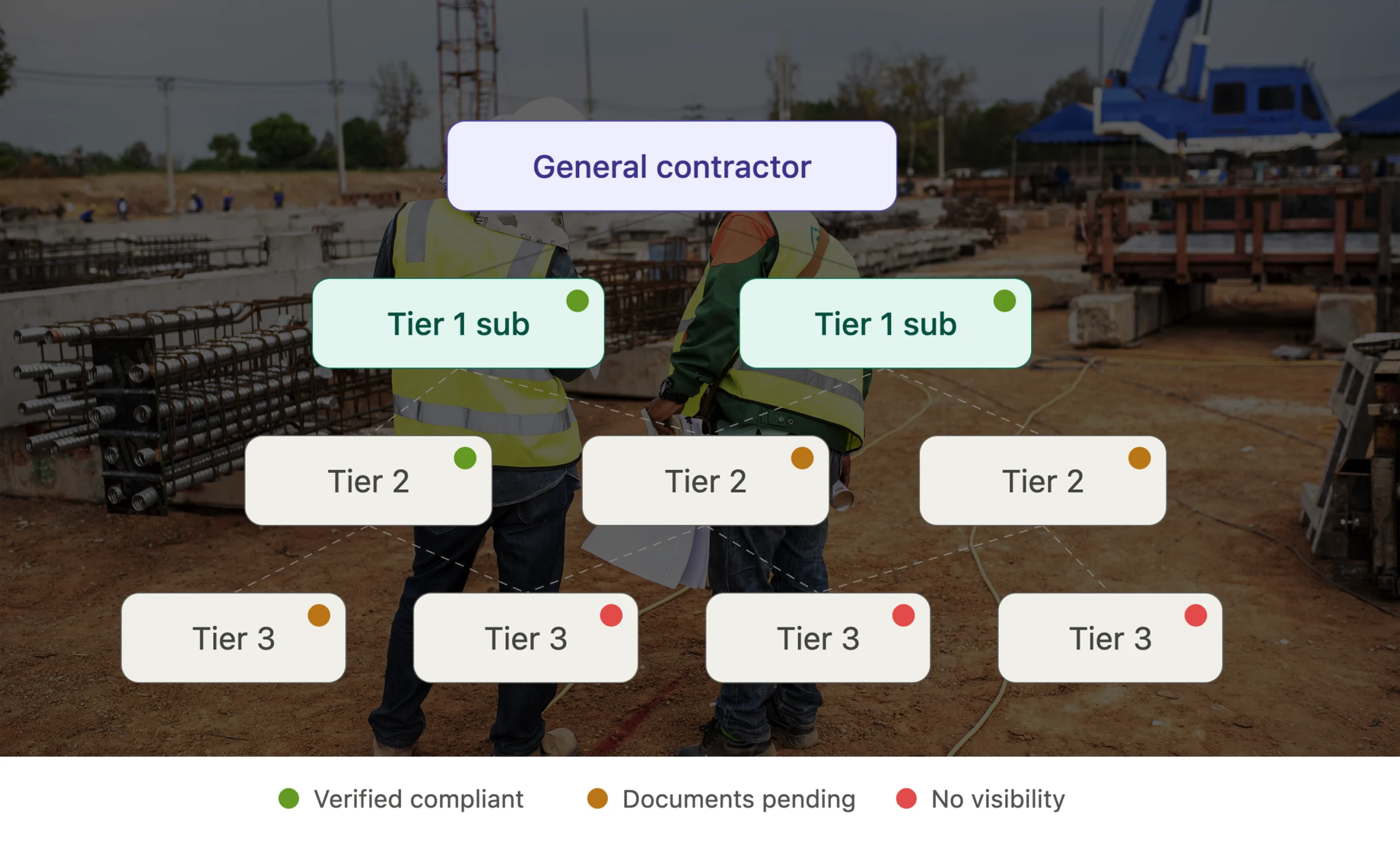

Contractor prequalification is intended to help organizations make better-informed decisions before outside companies begin work. But the process becomes less useful when every contractor is evaluated against the same set of requirements, regardless of what the contractor does.
A company providing occupational health services does not present the same risks as a scaffolding contractor. An electrical contractor should not be evaluated exactly like a landscaping company. A delivery vendor entering an administrative area should not automatically be subjected to the same qualification process as a contractor performing confined-space work or hazardous energy control.
When prequalification requirements are disconnected from the contractor’s scope of work, the result may be more paperwork, but not necessarily better risk management.
A stronger approach is to align qualification requirements with the contractor’s services, hazards, work location, workforce, and actual exposure.
What Is Scope-Specific Contractor Prequalification?
Scope-specific contractor prequalification is the practice of assigning requirements based on the work a contractor will perform rather than applying one universal checklist to every participating company.
The process begins with a straightforward question:
What risks does this contractor’s work introduce to the organization, its employees, the public, or the jobsite?
The answer should determine what information the contractor must provide.
Depending on the scope, relevant requirements may include:
- Safety performance data
- Applicable written safety programs
- Insurance coverage and limits
- Trade licenses
- Employee training and certifications
- Regulatory records
- Financial information
- Background screening
- Drug and alcohol testing
- Site- or project-specific acknowledgments
Not every contractor needs every item.
The objective is not to reduce standards. It is to make those standards more precise.
The Problem with Blanket Prequalification Requirements
Standardization has value. It promotes consistency, helps establish minimum expectations, and makes a contractor program easier to administer across multiple facilities or business units.
However, standardization becomes counterproductive when it turns into a blanket requirement policy.
A blanket policy treats requirements as universally applicable even when they have little or no relationship to the contractor’s actual services. This can cause several problems.
Irrelevant Deficiencies Can Affect Qualification Status
Consider an occupational health provider that performs physical examinations, drug screenings, and background checks. The company does not erect, inspect, dismantle, or work from scaffolding.
Requiring that provider to submit a scaffolding safety program would not meaningfully demonstrate its ability to provide occupational health services.
If the contractor does not have the irrelevant program, it may be marked deficient. If it creates a generic program simply to satisfy the requirement, the documentation still provides little useful information about the work being performed.
In either case, the qualification result may become less accurate.
Administrative Activity Can Be Mistaken for Risk Control
Collecting more documents can create the appearance of a comprehensive contractor compliance program. But document volume is not the same as risk visibility.
A useful prequalification process should help answer questions such as:
- Is the contractor capable of performing the assigned work?
- Does its safety program address the hazards associated with that work?
- Does it carry the appropriate insurance coverage?
- Are its employees properly trained and qualified?
- Does its performance history fall within the hiring organization’s standards?
- Can the organization document why the contractor was approved?
Documents that do not help answer those questions may add work without strengthening the decision.
Contractors May Submit Generic Policies
When contractors are required to maintain programs unrelated to their operations, they may obtain templates or create generalized policies solely to complete the qualification process.
A document may technically exist, but that does not establish that the contractor understands, implements, or needs the program.
This creates a distinction between document presence and operational relevance.
A defensible prequalification program should consider both.
Contractor Participation Can Suffer
Contractors are generally more receptive to qualification requirements when they understand why the information is being requested.
Resistance increases when requirements seem arbitrary, repetitive, or unrelated to the services provided. Smaller contractors may be particularly affected because they often have fewer administrative resources available to manage multiple qualification systems and document requests.
In some cases, contractors turn to outside services to manage third-party compliance submissions, adding another layer of cost and administration.
These issues are among the common reasons contractor compliance programs fail to achieve consistent participation.
Unnecessary requirements can contribute to:
- Delayed onboarding
- Incomplete submissions
- Increased administrative cost
- Repeated clarification requests
- Contractor frustration
- Lower program participation
- Difficulty maintaining current records
A rigorous program does not need to be an unnecessarily burdensome one.
Can Blanket Requirements Increase Liability?
It would be too broad to say that every standardized requirement automatically increases liability. The legal effect depends on the organization, contract, jurisdiction, work performed, and how the program is administered.
However, irrelevant requirements can create questions that organizations should consider carefully.
For example:
- Why was a particular program required if the contractor never performs that work?
- Was the submitted program meaningfully reviewed?
- Did approval indicate that the contractor was qualified for all listed activities?
- Were material work-related risks evaluated with the same attention as irrelevant documentation?
- Does the qualification status accurately describe the contractor’s approved scope?
- Can the organization explain the reasoning behind its approval decision?
A qualification program is most defensible when requirements and decisions can be connected to a documented rationale.
The organization should be able to show not only what it collected, but also why each requirement applied.
Why a Universal Rating Can Be Misleading
A single rating can be useful for quickly communicating contractor status. The problem arises when that rating combines relevant and irrelevant requirements without sufficient context.
Suppose a medical services contractor receives a lower qualification score because it does not have a scaffolding program. The rating may suggest that the contractor presents an elevated risk even though the alleged deficiency has no relationship to its work.
The opposite problem can also occur. A contractor may receive a broadly acceptable status even though an important scope-specific issue has not received enough attention.
Qualification results should therefore reflect:
- The work the contractor is approved to perform
- The applicable locations or projects
- The relevant hazards
- Any outstanding exceptions
- The client’s defined approval thresholds
- The duration of the approval
- Conditions requiring reevaluation
A contractor should not simply be labeled “qualified” in the abstract. It should be qualified for a defined scope under established conditions.
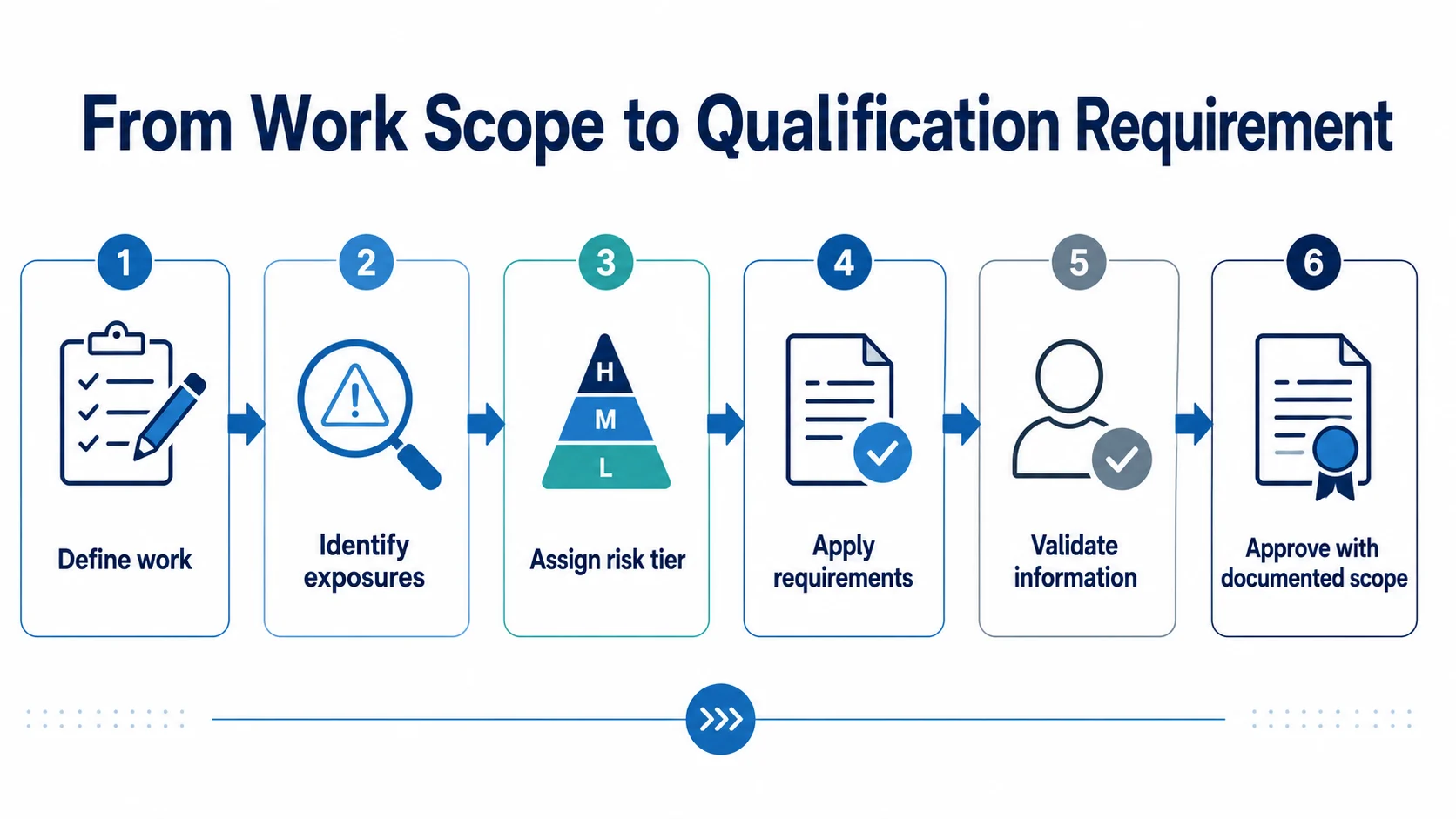
A Practical Framework for Assigning Contractor Requirements
Organizations do not need to create an entirely different qualification program for every contractor. A structured requirement matrix can provide consistency while preserving relevance.
1. Define the Contractor’s Scope
Begin by documenting the services the contractor will provide.
The description should be more precise than a broad category such as “maintenance,” “consulting,” or “construction.” Identify the activities the contractor’s employees will perform.
For example:
- Will employees work at height?
- Will they enter confined spaces?
- Will they operate vehicles or mobile equipment?
- Will they interact with hazardous chemicals?
- Will they perform electrical work?
- Will they access sensitive information?
- Will they work directly with patients or employees?
- Will they supervise subcontractors?
- Will they enter active production areas?
Clear scope definitions support better requirement assignments.
2. Identify the Associated Exposures
Evaluate the safety, insurance, operational, financial, security, and regulatory exposures created by the work.
The assessment should consider more than the contractor’s company name or trade classification. Two contractors in the same general category may perform materially different work.
A janitorial contractor cleaning administrative offices may have different requirements from one cleaning industrial process equipment. An electrical contractor performing low-voltage office installations may present different exposures from one servicing high-voltage systems.
3. Establish Risk Tiers
Contractors can be grouped into practical risk tiers based on their work.
A simplified model may include:
Lower-risk contractors
Examples may include office vendors, certain consultants, delivery services, and suppliers that do not perform operational work.
Requirements may focus on basic company information, applicable insurance, legal documentation, and site access expectations.
Moderate-risk contractors
Examples may include routine maintenance providers, cleaning contractors, equipment technicians, and vendors entering operational areas.
Requirements may include additional safety documentation, employee qualifications, training records, and more detailed insurance review.
Higher-risk contractors
Examples may include contractors performing work at height, confined-space entry, hot work, hazardous-material handling, heavy construction, excavation, or energy isolation.
Requirements may include detailed written programs, safety-performance validation, workforce credentials, applicable audits, project-specific documentation, and enhanced ongoing monitoring.
Risk tiers should guide the process, but they should not replace professional judgment. The actual scope remains the determining factor.
4. Assign Applicable Requirements
Each requirement should be connected to a specific exposure, contractual obligation, client standard, or regulatory consideration.
A requirement matrix might identify:
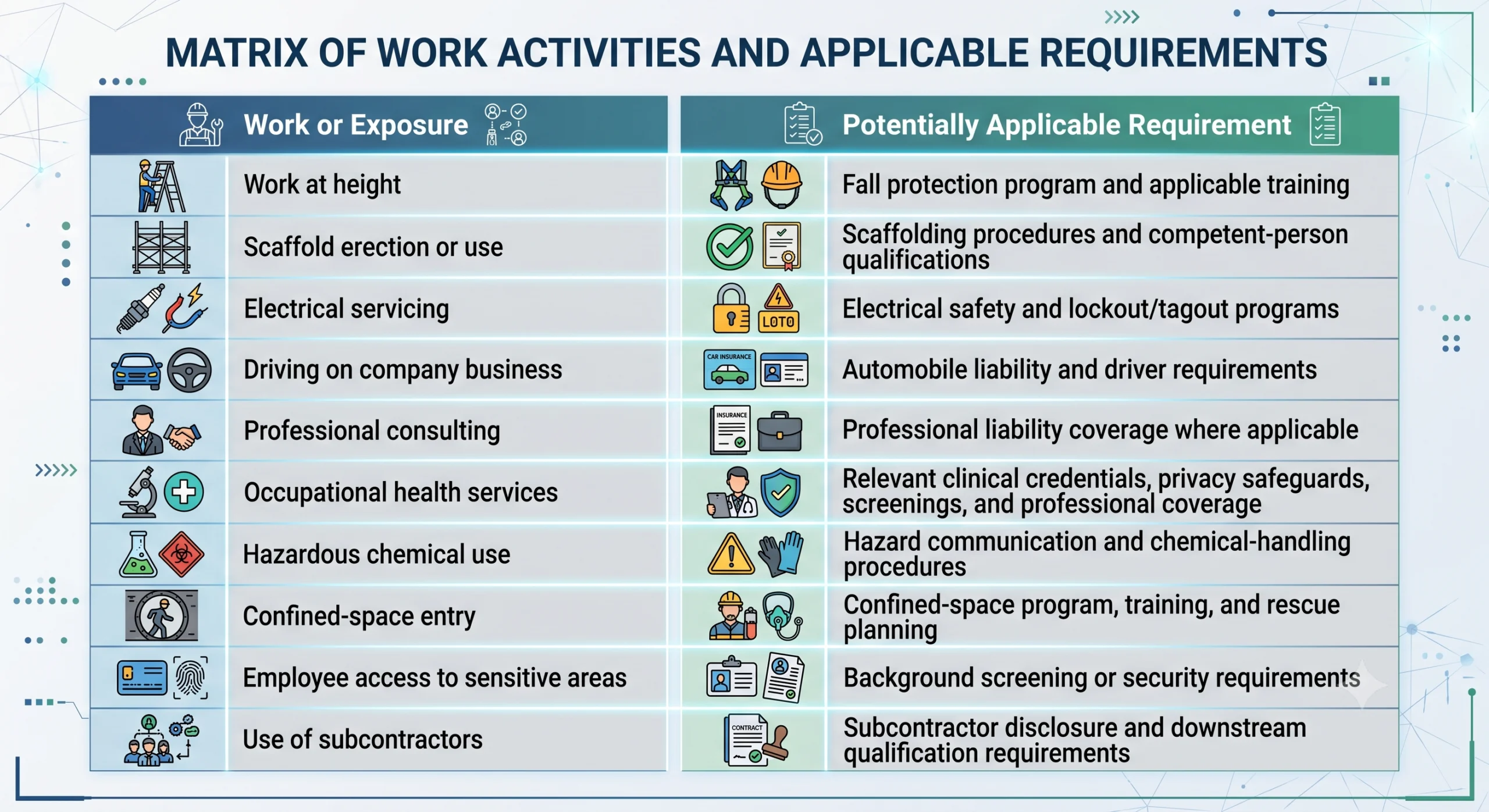
This makes the program easier to explain, administer, and defend.
5. Validate Against Client-Defined Standards
The hiring organization should retain control over its qualification standards and approval thresholds.
Prequalification support should not replace the client’s authority. Instead, it should ensure that contractor information is collected, organized, and validated consistently against the client’s defined criteria.
That includes identifying:
- Complete submissions
- Missing information
- Requirements that do not meet established thresholds
- Expired documents
- Exceptions requiring client review
- Material changes that may affect status
The final approval decision remains with the organization responsible for the work.
6. Document Exceptions and Decisions
Not every contractor will fit neatly into a predetermined category. A well-designed program should support documented exceptions rather than forcing an inaccurate result.
For each exception, record:
- The requirement involved
- Why it was considered inapplicable or modified
- Who authorized the decision
- Any alternative documentation accepted
- Any limitations placed on the contractor’s work
- When the decision must be reconsidered
This creates a stronger audit trail than silently waiving a requirement or marking a contractor deficient for an irrelevant item.
7. Reevaluate When the Scope Changes
Qualification should not be treated as a permanent company-wide approval.
A contractor initially hired for low-risk consulting services may later be asked to perform onsite technical work. A maintenance provider may expand into electrical work, confined-space entry, or equipment installation.
Material changes in scope should trigger a review of:
- Safety requirements
- Insurance coverage
- Employee qualifications
- Site access
- Regulatory obligations
- Approval status
Prequalification is most accurate when it follows the work rather than only the contractor’s identity.
Scope-Specific Does Not Mean Less Rigorous
A common concern is that tailoring requirements will weaken the contractor program or create inconsistent standards.
That is not the objective.
Scope-specific prequalification means applying the right level of rigor to the right exposure.
High-risk contractors may require a more detailed review than they would receive under a generic checklist. At the same time, lower-risk providers are not burdened with policies that do not apply to their operations.
A properly configured program can be both consistent and flexible:
- Consistent in how risks are classified
- Consistent in how documentation is reviewed
- Consistent in how thresholds are applied
- Flexible in which requirements apply
- Flexible across locations and scopes
- Flexible when documented exceptions are justified
Consistency should govern the decision-making process, not force every contractor through an identical document list.
This balance is also central to effective supplier management through prequalification.
How CanQualify Supports a More Relevant Process
CanQualify helps organizations establish scope and risk-based qualification requirements according to their own standards, work scopes, trades, and locations.
Rather than relying on document collection alone, the process combines configurable technology with hands-on program support.
Depending on the client’s needs, this may include:
- Defining scope- and risk-based qualification requirements
- Conducting contractor outreach and follow-up
- Guiding contractors through applicable requirements
- Collecting and organizing documentation
- Validating submissions against client-defined criteria
- Reviewing applicable safety performance information
- Validating insurance against established thresholds
- Tracking employee training and credentials
- Monitoring expirations and material changes
- Documenting qualification status and exceptions
- Providing centralized program visibility
The client maintains control of its standards and approval decisions. CanQualify helps make the program practical, understandable, and consistently administered.
Questions to Ask About Your Current Prequalification Program
Safety, procurement, operations, and risk leaders can use the following questions to evaluate whether their program is producing meaningful qualification results:
- Are requirements assigned according to actual work scope?
- Can each requirement be connected to a relevant exposure?
- Are low-, moderate-, and high-risk contractors treated differently?
- Are contractors being penalized for policies unrelated to their services?
- Does the qualification rating clearly identify the approved scope?
- Are submitted documents reviewed for relevance, not merely presence?
- Are exceptions documented and authorized?
- Are requirements reevaluated when a contractor’s work changes?
- Can contractors receive a clear explanation of what is required and why?
- Can the organization demonstrate the basis for each approval decision?
If the answers are unclear, the issue may not be the contractors. The qualification program itself may need to be reconsidered.
Better Requirements Produce Better Risk Information
Contractor prequalification should help organizations distinguish between companies that are appropriately prepared for the work and those that introduce unacceptable or unresolved risk.
That distinction becomes harder when qualification requirements are too broad, irrelevant, or disconnected from actual exposure.
A scope-specific approach provides a more accurate basis for contractor evaluation. It reduces unnecessary administrative work, improves contractor understanding, and gives hiring organizations clearer information for making approval decisions.
The goal is not to collect the greatest possible number of policies.
The goal is to collect and validate the information that helps determine whether a contractor is qualified to perform the work being assigned.
This article reflects CanQualify’s experience supporting contractor prequalification programs across multiple industries. Qualification requirements should be established by each organization according to its work, risk profile, contractual obligations, and applicable legal or regulatory requirements.