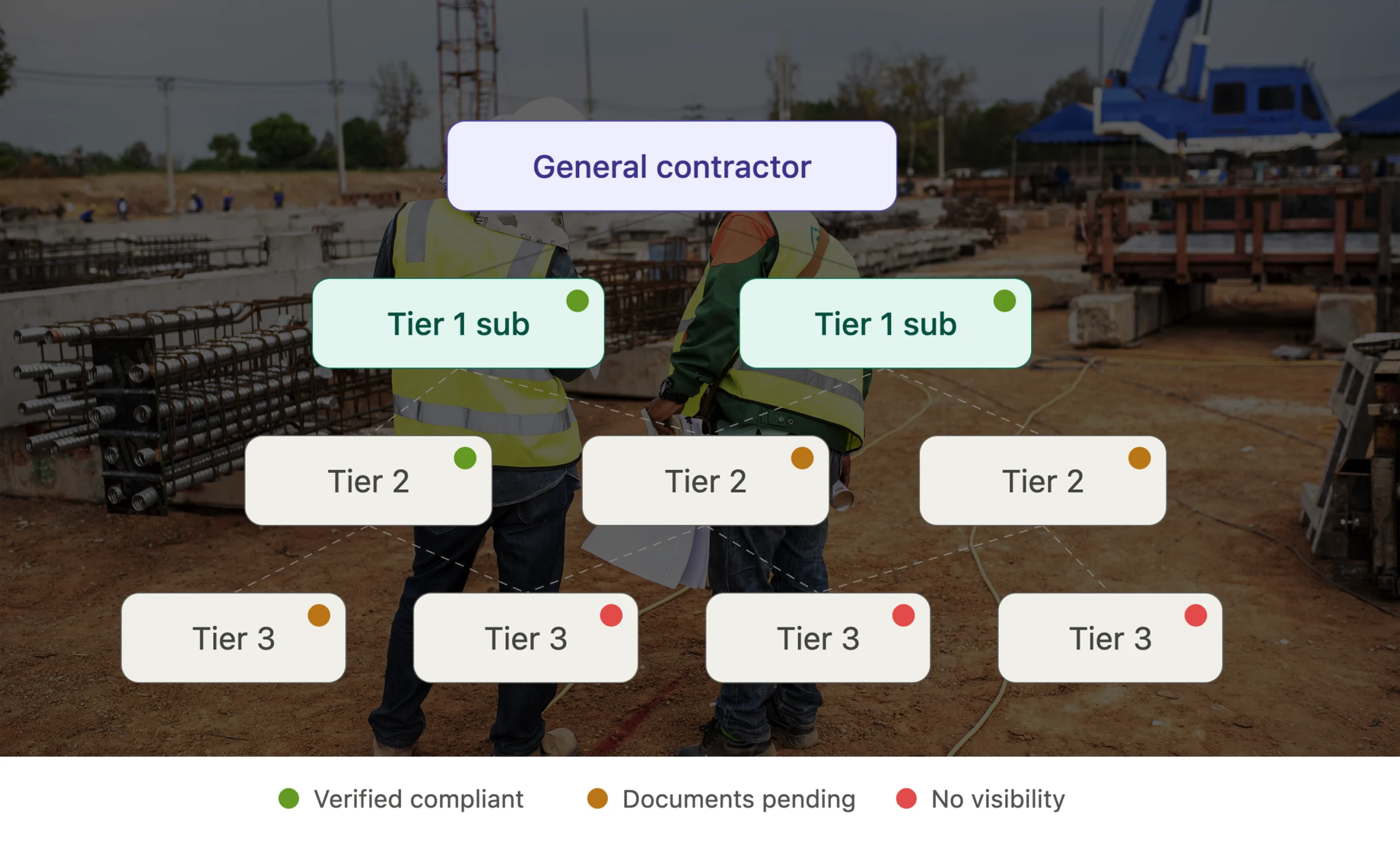
Contractor prequalification has become an established part of doing business in construction, manufacturing, energy, defense and aerospace, utilities, mining, oil and gas, chemicals, and other industries where outside companies perform potentially hazardous work.
That is a good thing.
A structured qualification process helps an organization understand who they are hiring before work begins. Safety performance can be reviewed. Insurance can be validated. Written programs, licenses, certifications, financial information, regulatory history, and other requirements can be evaluated against established criteria.
But passing prequalification answers only one question:
Does this contractor meet our requirements to be considered for this work?
It does not answer an equally important question:
What happens to the risk after the contractor is approved?
Those questions are not interchangeable.
Prequalification is a point-in-time decision. Contractor risk management is a continuous process.
Insurance expires. Experience Modification Rates change. Incidents occur. Employees and supervisors leave. Certifications lapse. Subcontractors are added. Work scopes expand. Site conditions change.
Once work begins, something that did not exist during prequalification becomes available: direct evidence of how the contractor actually performs.
Approval should not be viewed as the conclusion of contractor risk management.
It is one decision gate within a much larger lifecycle.
Approval is a Starting Point, Not a Safety Outcome
Consider a familiar situation.
An industrial facility hires an electrical contractor for a six-month project. Before mobilization, the contractor satisfies the facility’s requirements. Insurance is current. Safety statistics fall within established thresholds. Required programs have been reviewed. Employee qualifications are confirmed.
The contractor is approved.
Three months later, the situation may look different.
The supervisor who mobilized the project may have left. New employees may have joined the crew. A subcontractor may have been added. More importantly, the work itself may have changed.
What began as routine electrical maintenance may now involve energized systems, elevated work, confined spaces, a shutdown, or other exposures that were not part of the original qualification decision.
The contractor may still be an excellent company for these tasks.
But in this case, the basis for the original risk decision has changed.
That distinction matters.
OSHA’s Recommended Practices for Safety and Health Programs recognize the need for communication and coordination among host employers, contractors, and staffing agencies. The guidance calls for information about hazards and controls to be communicated before work begins and as needed, when conditions change.
OSHA’s Multi-Employer Citation Policy makes a related point. When considering reasonable care by a controlling employer, OSHA identifies factors such as the nature and pace of the work, how frequently hazards change, the contractor’s safety history and practices, periodic inspections, correction of hazards, enforcement, and follow-up.
The practical lesson is straightforward:
Selecting a capable contractor matters.
What happens afterward matters too.
A Contractor Is Not Simply Qualified. A Contractor Is Qualified for Something.
One of the most useful shifts an organization can make is to stop thinking of qualification as a permanent characteristic attached to a company’s name.
A contractor should not simply be qualified.
A contractor should be qualified for something.
A landscaping company, engineering consultant, scaffolding contractor, industrial cleaning company, electrical contractor, and crane operator should not automatically face identical requirements.
Their exposures are different.
Even within one company, risk can change substantially according to the assignment. An electrical contractor performing low-voltage maintenance does not present the same exposure as that same contractor performing energized high-voltage work.
The contractor did not necessarily become riskier.
The assignment did.
That leads to a more useful way to think about contractor risk:
Risk exists at the intersection of the contractor, the people performing the work, the work itself, and the conditions under which it is performed.
The better sequence is:
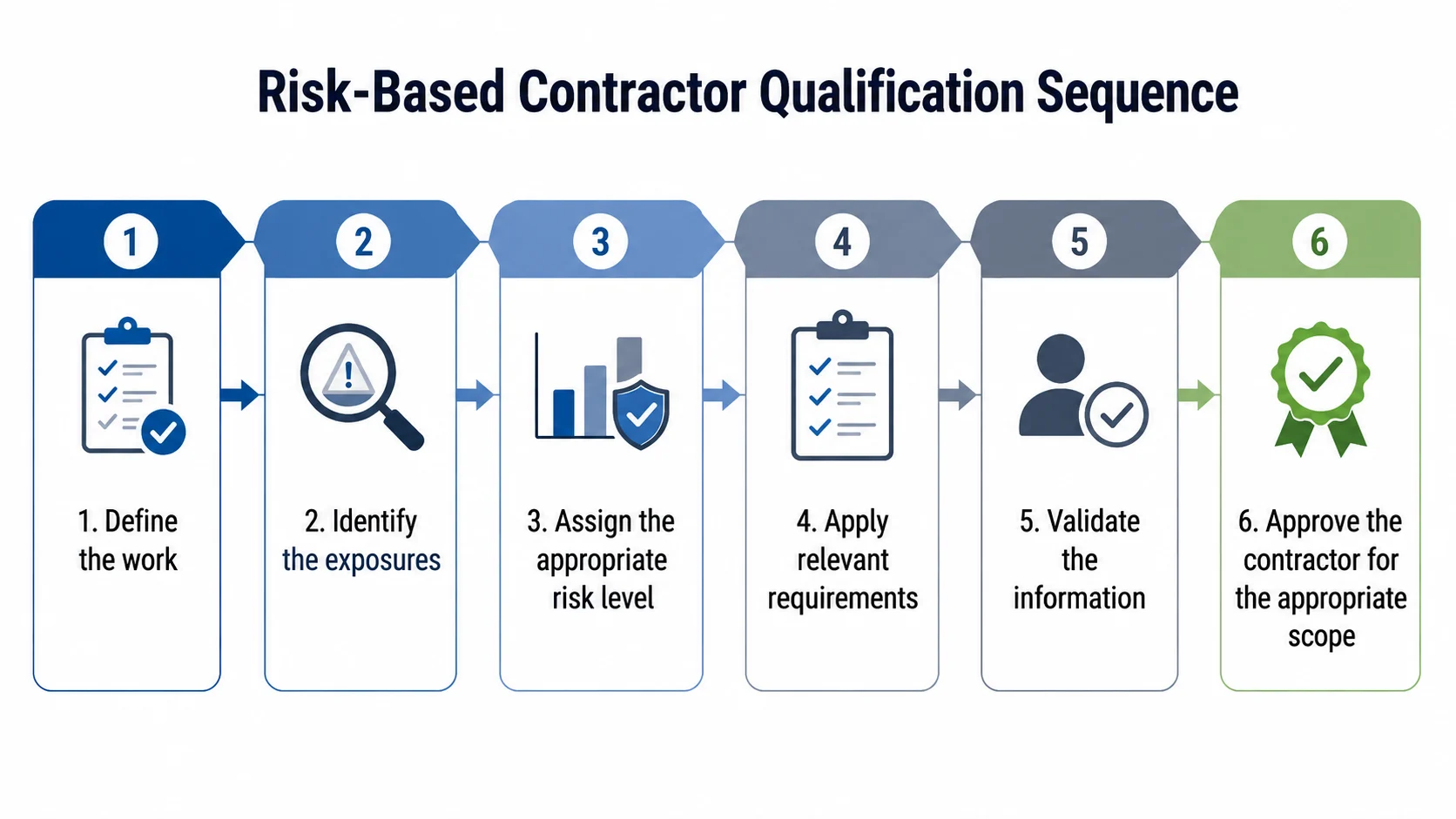
The depth of qualification and monitoring should be proportional to the work.
A contractor performing low-exposure office services should not necessarily be subjected to the same requirements or level of oversight as a contractor performing confined-space entry, crane operations, energized electrical work, or hazardous-material handling.
The level of attention should reflect the exposure, complexity of the work, and potential consequences if controls fail.
That is risk-based contractor management.
Prequalification Uses Proxies. Active Work Creates Evidence.
Before hiring a contractor, an organization must make its decision largely from historical information.
TRIR, DART, EMR, regulatory history, insurance, written programs, training records, certifications, previous experience, financial information, and similar data can all provide useful evidence.
But they have limits.
A questionnaire cannot tell you what is happening at 10:30 Tuesday morning on a jobsite.
A current certificate of insurance cannot tell you whether an employee is following lockout/tagout procedures.
A strong TRIR cannot tell you whether today’s excavation is properly protected.
A written fall-protection program can demonstrate that a contractor has established procedures. It cannot demonstrate, by itself, that those procedures are being followed on today’s job.
This does not make historical measures unimportant.
It makes them what they are: inputs into a decision made under uncertainty.
Research from the Campbell Institute at the National Safety Council reinforces the importance of looking beyond prequalification. Its contractor-management model identifies prequalification as only one stage of a broader lifecycle that also includes pre-job task assessment, training and orientation, job monitoring, and post-job evaluation.
Before work begins, companies manage uncertainty using proxies. After work begins, they can manage risk using direct evidence.
Once the relationship is active, the hiring organization can observe whether concerns are communicated, whether corrective actions are closed, whether employees follow site requirements, whether supervisors are engaged, whether incidents and near misses are reported promptly, and whether written programs are reflected in field practices.
In many cases, what you learn from working with the contractor tells you more about how they are performing today than another prequalification questionnaire ever could.
Continuous Does Not Mean Constant
“Continuous contractor risk management” can sound as though every contractor needs to be reevaluated every day.
That is not the objective.
Continuous does not mean constant intervention. It means that material changes can be recognized and evaluated throughout the contractor relationship rather than waiting for the next annual review or requalification cycle.
Some information may warrant automated monitoring. Some may be reviewed periodically. Some should trigger action only when a defined threshold is crossed. Other risks are best understood through field observations, audits, incident reviews, supervisor interaction, or project closeout.
The frequency and depth of monitoring should be proportional to the contractor’s work, exposure, history, and potential consequence of failure.
That distinction prevents a risk-based program from becoming a paperwork-based program.
Continuous Monitoring Is Necessary. But It Is Not Continuous Risk Management.
Technology can make contractor management substantially more effective.
A system can:
- Identify when insurance expires
- Flag a required credential that is no longer current
- Identify when a safety metric crosses an established threshold
- Surface missing documents
- Track corrective actions
- Validate defined requirements
- Make important information visible to people who previously had to chase it down manually.
Those capabilities matter.
But there is an important distinction between continuous data monitoring and continuous risk management.
Software can identify a change.
It cannot always determine what that change means operationally.
An expired certificate of insurance may require an updated document.
A new subcontractor may require qualification.
A change in work scope may require different programs, credentials, controls, or approval.
An unresolved field finding may require corrective action.
A serious incident may warrant management review, restricted scope, or suspension.
Those are not the same decisions simply because each can create a red flag on a dashboard.
A change in data does not automatically mean risk has increased. It may mean the basis for the previous risk decision needs to be reconsidered.
Technology improves visibility.
People must still understand the work, evaluate the significance of the change, verify conditions in the field where appropriate, and decide what happens next.
The strongest contractor programs connect those activities.
The future of contractor risk management should not be automated decision-making. It should be better-informed decision-making.
Monitor Changes That Require Decisions
More data does not automatically produce better risk management.
An organization can collect hundreds of contractor data points and still struggle to answer the most practical question:
Who requires our attention today, and why?
That should be one of the primary objectives of monitoring.
Material changes might include:
- Required insurance expiring or falling below established limits
- An employee credential or certification lapsing
- Safety performance crossing a client-defined threshold
- A regulatory action requiring review
- A new subcontractor being added
- Work scope changing enough to introduce new exposures or requirements
- A significant field-audit finding
- A corrective action remaining unresolved
But identifying the event is only the beginning.
The response might range from a document update to additional review, field verification, corrective action, additional controls, restricted scope, or suspension.
That distinction matters.
A red flag should begin a decision process, not automatically substitute for one.
The objective is not to build the largest possible compliance record.
It is to recognize meaningful changes and get the right information to the person who needs to make a decision.
Risk Can Change Because the Contractor Changed – or Because Everything Around the Contractor Did
It is tempting to think of ongoing monitoring primarily as watching the contractor for deterioration.
But contractor risk can change even when the contractor itself has changed very little.
The workforce changes when experienced employees leave or new employees arrive.
The assignment changes when routine maintenance becomes higher-hazard work.
Site conditions change when other contractors enter the area, production schedules shift, equipment is energized, weather affects the work, or a shutdown introduces new exposures.
The contractor may be the same company that was approved months ago. But may no longer be performing the same work under the same conditions.
That is why contractor risk management must connect company-level qualification information with what is actually happening where the work is being performed.
Written Programs and Field Implementation Answer Different Questions
There are really two separate questions:
Does the contractor have an appropriate written program?
And:
Is the contractor implementing it?
Both matter.
A written respiratory-protection program, for example, can be reviewed for required elements. But the existence of that document does not tell you whether affected employees have received the appropriate medical evaluations, fit testing, training, and equipment.
The same distinction applies to fall protection, scaffolding, lockout/tagout, confined-space entry, rigging, hazard communication, and many other safety programs.
Document review establishes one form of evidence.
Implementation provides another.
A mature contractor-risk program knows the difference.
Do Not Waste What You Learn During the Work
Contractor programs often place enormous effort at the front of the lifecycle and surprisingly little at the back.
That is a missed opportunity.
Campbell Institute research examining contractor-management practices found that only five participating organizations had a post-job evaluation process or specific guidelines for contractor requalification.
Think about what an organization may learn after months of working with a contractor:
- Whether employees consistently follow site requirements
- Whether corrective actions are closed promptly
- Whether incidents are communicated transparently
- Whether the contractor handles unexpected changes well
Why lose that information when the purchase order closes?
The next qualification decision should not begin from zero.
Contractor management becomes far more useful when the organization stops repeatedly asking only:
What did this contractor tell us?
and also asks:
What did we learn by working with them?
That information should improve future qualification, sourcing, work-scope, and requalification decisions.
The Contractor Risk Loop
A mature contractor-risk program does not need to become excessively bureaucratic.
It needs continuity.
A practical way to think about that continuity is the Contractor Risk Loop:
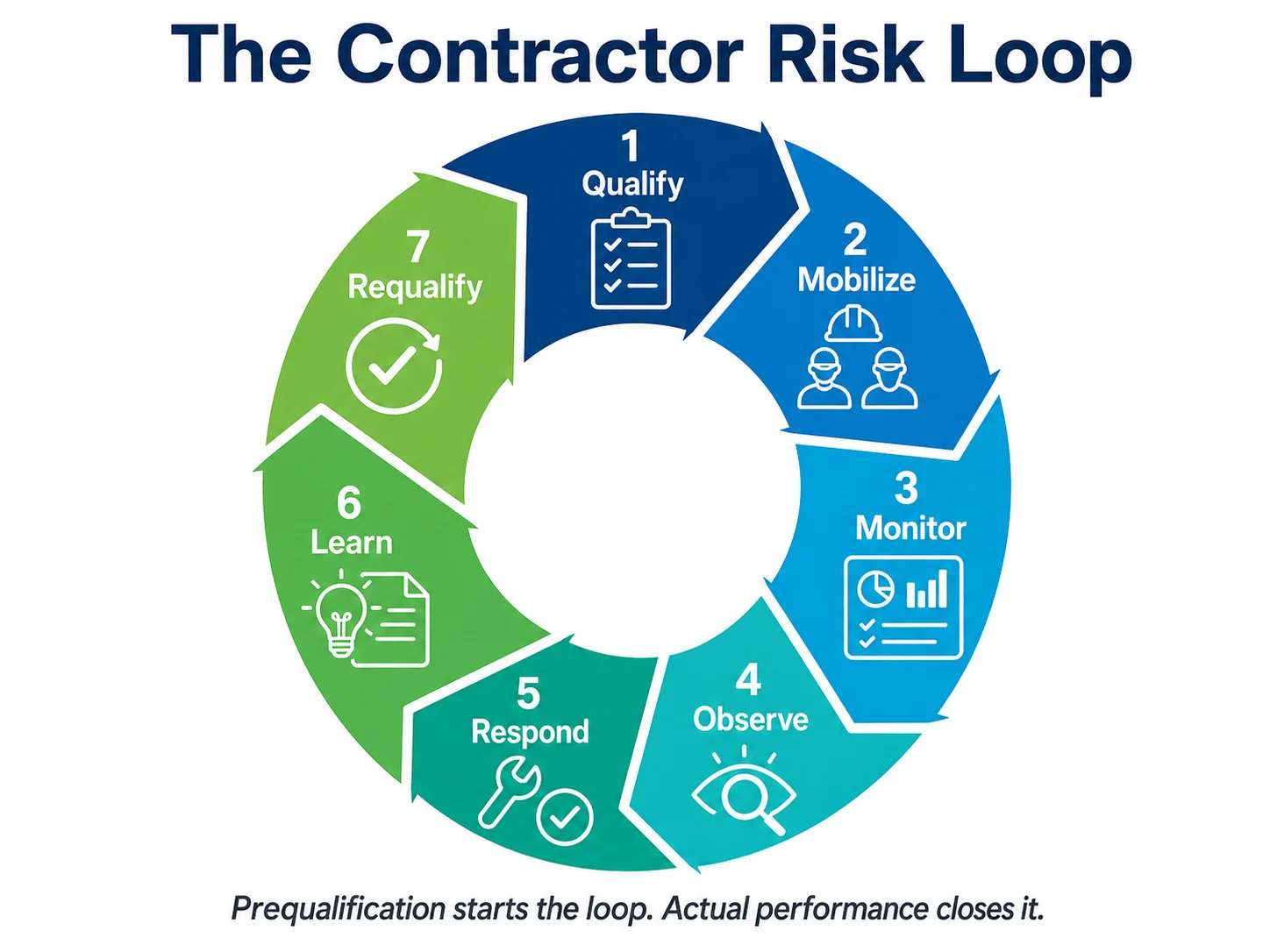
Qualify
Determine whether the contractor meets requirements appropriate to the proposed work and exposure.
Mobilize
Resolve outstanding requirements, verify workforce or site-specific information, communicate expectations, and confirm readiness before work begins.
Monitor
Watch defined information that can materially affect the qualification decision.
Observe
Use field inspections, observations, audits, incident reporting, supervisor interaction, and other direct experience to understand how requirements are being implemented.
Respond
Evaluate exceptions and determine the appropriate response.
Learn
Capture what actual experience with the contractor revealed—not only failures, but strong performance as well.
Requalify
Use what was learned to make the next qualification, sourcing, and work-scope decision better than the last one.
Prequalification starts the loop. Actual performance closes it.
And then the process begins again with better information.
Five Questions That Reveal What Kind of Program You Have
Organizations do not necessarily need a complicated maturity model to identify gaps in contractor management.
Start with five questions:
- Do our qualification requirements change according to the work and exposure, or do most contractors receive essentially the same requirements?
- After approval, do we know when information that materially affects the original qualification decision changes?
- Do significant changes trigger a defined review or escalation process rather than simply generating a notification?
- Does actual field performance influence how we evaluate and manage the contractor?
- Does what we learn during one project affect the contractor’s next qualification, sourcing, or work-scope decision?
If an organization has a strong process for the first question but little capability around the remaining four, it may have an effective prequalification program.
It does not yet have a complete contractor risk-management process.
Where CanQualify Fits
We view prequalification as an important part of a broader contractor compliance and risk-management process.
The objective is not simply to collect more information or impose more requirements.
It is to help organizations establish requirements appropriate to the work being performed, collect and validate the information needed to evaluate those requirements, recognize important changes, and make relevant information available to the people responsible for contractor decisions.
Depending on the organization and the work, that can include safety performance, insurance, employee credentials, written programs, financial risk, regulatory information, audit findings, and other client-defined requirements.
Just as important, the hiring organization retains control over its standards and its decisions.
A third-party platform can organize information, validate defined requirements, monitor data, identify exceptions, and improve visibility.
It cannot, and should not, replace the judgment of the people responsible for understanding and managing the work.
Better technology should make important information easier to recognize and act upon.
It should not create the illusion that collecting enough data eliminates the need for competent risk management.
The Goal Isn’t More Compliance. It’s Better Decisions.
Contractor prequalification has enormous value when it is treated as what it actually is: a structured method for making a better decision before work begins.
Problems arise when approval is treated as proof of future safety.
It isn’t.
Yesterday’s qualification decision may no longer reflect today’s work, workforce, or conditions.
But the opposite is also true.
Today’s work can provide evidence that yesterday’s qualification process did not have.
A contractor can demonstrate strong supervision, prompt corrective action, transparent reporting, consistent field performance, and the ability to adapt when conditions change.
That should matter the next time the organization makes a decision.
The goal is not more compliance activity.
It is better decisions when circumstances change.
The question organizations should ask is not simply:
Are our contractors qualified?
It is:
Are they qualified for the work they are performing, and do we have the information and processes necessary to recognize when the basis for that decision changes, learn from actual performance, and act when it matters?
That is the difference between maintaining a qualification list and managing contractor risk.