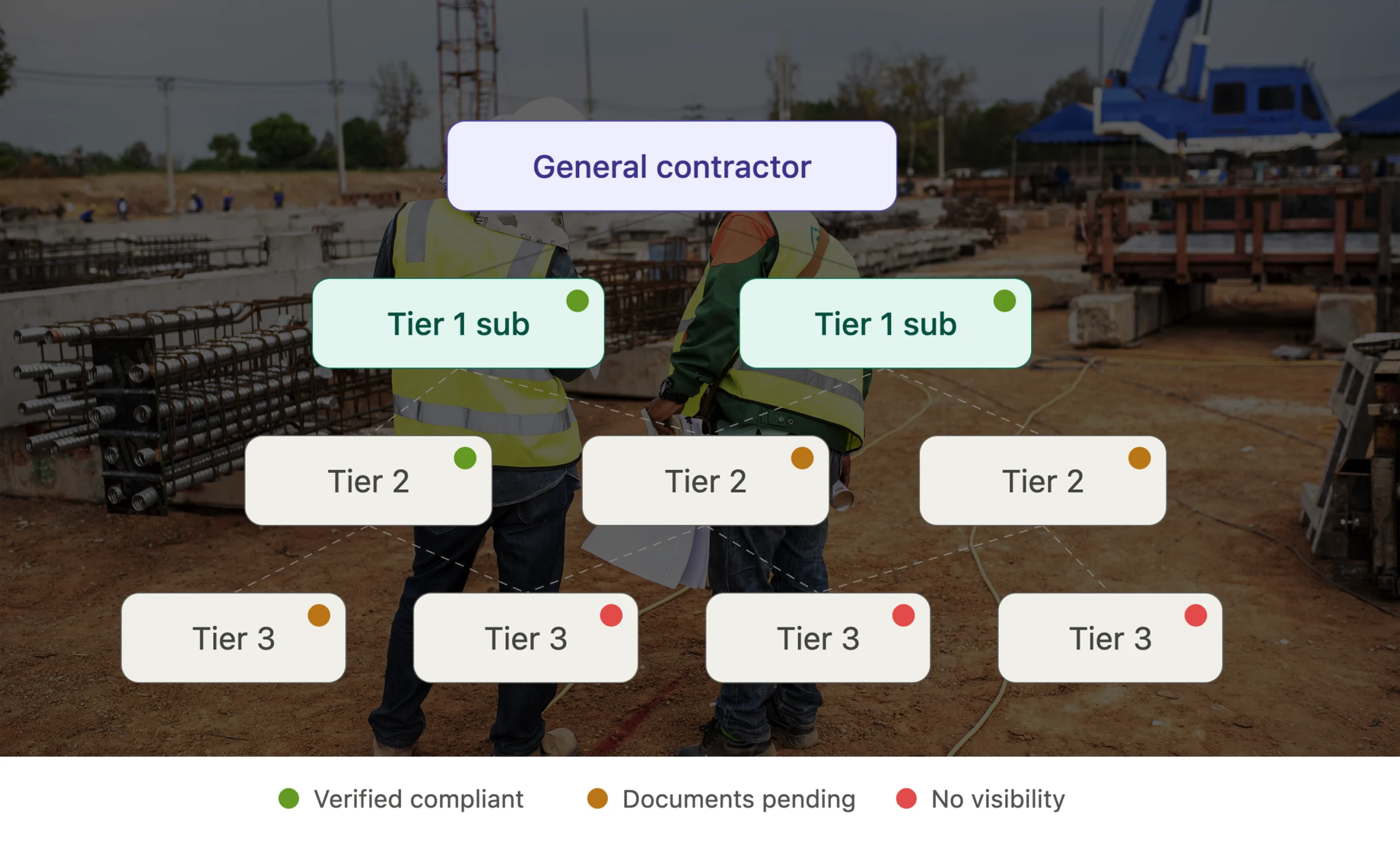

Contractor prequalification has shifted from a safety-first risk management function into a high-margin private equity asset class: and hiring organizations are unknowingly paying the price.
What was once largely an administrative function, collecting safety records, insurance certificates, and qualification documents, has evolved into a global software and services industry attracting billions of dollars in private equity, growth capital, and acquisition activity.
The investment itself is not necessarily a problem. Better technology, greater automation, and stronger risk management can benefit both hiring clients and the suppliers performing the work.
But the rapid commercialization and consolidation of contractor management also raise an important question: As more capital flows into prequalification, who ultimately pays for the growth?
Increasingly, part of that burden falls on suppliers. These contractors and service providers may now maintain accounts with several competing prequalification networks simply because different customers require different systems. Each platform brings another subscription, another profile, another set of requirements, and another administrative process.
Those costs do not disappear. Suppliers either absorb them, reducing their margins, or incorporate them into the prices they charge hiring clients.
Capital Finds Contractor Management
Institutional investors began recognizing the economics of contractor-management networks well before the current wave of consolidation. Private equity firms rely heavily on buy-and-build strategies, acquiring competing platforms to capture network effects and create a captive, recurring revenue stream from contractors who have no choice but to pay if they want to work.
In 2012, Norwest Venture Partners invested in PICS Auditing, the company that ultimately became Avetta. The Wall Street Journal later reported that investment at approximately $35 million. The investment was first reported by the Wall Street Journal, and you can read the full case study on the Norwest Venture Partners Blog.
The scale increased dramatically from there.
Welsh, Carson, Anderson & Stowe acquired a majority stake in Avetta in 2018 through a transaction of approximately $500 million, according to the Journal. Under that ownership, Avetta expanded both organically and through acquisition – including the 2019 purchase of competitor BROWZ and the 2021 acquisition of Australian worker-management provider Pegasus.
ISN followed a different path but attracted institutional capital of its own. In December 2020, Blackstone Growth announced a significant minority investment in ISN that valued the contractor and supplier management company at more than $2 billion.
Then came another significant valuation benchmark.
In 2024, EQT agreed to acquire Avetta from Welsh Carson. Financial terms were not officially disclosed, but The Wall Street Journal reported that the transaction valued Avetta at more than $3 billion, including debt.
Veriforce offers perhaps the clearest illustration of a private-equity-backed roll-up strategy.
Thoma Bravo invested in Veriforce in 2018. PEC Safety and Veriforce merged the following year, creating a combined contractor safety and compliance platform. Veriforce subsequently acquired ComplyWorks in 2020, ComplyWorks Africa in 2021, CHAS in the United Kingdom in 2023, and other capabilities as it expanded geographically and functionally.
When Thoma Bravo sold its controlling stake in Veriforce to Apax Partners in December 2024, financial terms were not disclosed. But Thoma Bravo reported something potentially more revealing: during its five years of ownership, Veriforce achieved sixfold revenue growth through organic initiatives and strategic M&A.
The pattern is difficult to miss. Contractor prequalification has evolved into an attractive category for institutional investors seeking low churn, high-margin software revenues, and captive supplier monetization.
INVESTMENT TIMELINE
- 2012 Avetta/PICS: Norwest invests approximately $35 million in PICS Auditing, later Avetta.
- 2018 Avetta: Welsh Carson acquires a majority stake through an approximately $500 million transaction.
- 2018–2019 Veriforce: Thoma Bravo invests in Veriforce; Veriforce and PEC Safety combine into a larger contractor compliance platform.
- 2019 Avetta/BROWZ: Avetta acquires competitor BROWZ, expanding its supplier qualification network.
- 2020 ISN: Blackstone Growth invests in ISN at a valuation exceeding $2 billion.
- 2020 Veriforce/ComplyWorks: Veriforce acquires Canadian compliance-management provider ComplyWorks.
- 2021 Avetta/Pegasus: Avetta acquires Pegasus, expanding into worker competency and workforce management.
- 2023 Veriforce/CHAS: Veriforce completes its acquisition of UK contractor-management provider CHAS.
- 2024 Avetta/EQT: EQT acquires Avetta in a transaction reportedly valuing the business at more than $3 billion including debt.
- 2024 Veriforce/Apax: Apax acquires the controlling stake in Veriforce from Thoma Bravo following a period in which Veriforce reports sixfold revenue growth.
The Supplier Pays More Than the Subscription
The most obvious supplier impact is price. ISNetworld publicly states that contractors and suppliers pay annual subscription and setup fees based on workforce size and geography, and that pricing is subject to annual change.
Third-party historical pricing records provide a useful picture:
- 2021: Smallest published U.S. ISNetworld tier carried a $750 annual subscription fee.
- 2022: Pricing references reported a $750 annual charge.
- 2024: Published pricing listed the smallest annual fee at $800.
- 2026: Pricing sources put the contractor/supplier starting subscription at approximately $875 annually.
That represents roughly a 16.7% increase in the documented base annual subscription between 2021 and 2026.
However, focusing only on the base subscription drastically understates the financial pressure. The primary burden is platform multiplication. A supplier serving several industrial customers may encounter ISNetworld for one client, Avetta for another, and Veriforce for a third. Each platform requires a distinct subscription, profile, and set of requirements.
The Hidden Cost to Hiring Clients & Diversity Goals
Suppliers faced with mandatory third-party platform expenses have limited options. When compliance overhead rises, contractors must absorb the added cost, reduce expenses elsewhere, or recover it through their pricing.
Industry discussions among safety professionals suggest that some suppliers explicitly pass enrollment fees back to hiring clients, while others incorporate these expenses into their overhead and burden rates. Either way, the cost does not disappear. A $1,000 compliance fee paid by a contractor ultimately becomes part of the cost of serving its customers, and, when recovered through pricing, contributes to higher project bids.
Worse, high subscription costs and administrative friction disproportionately impact small businesses, specialized trade vendors, and local, minority-owned contractors who lack dedicated compliance departments. When burdensome TPA entry fees force qualified local or diverse suppliers to opt out of bidding, hiring clients face reduced market competition, higher general condition costs, and unintended barriers to their corporate supplier diversity targets.
Administrative Overhead vs. Real-World Risk Reduction
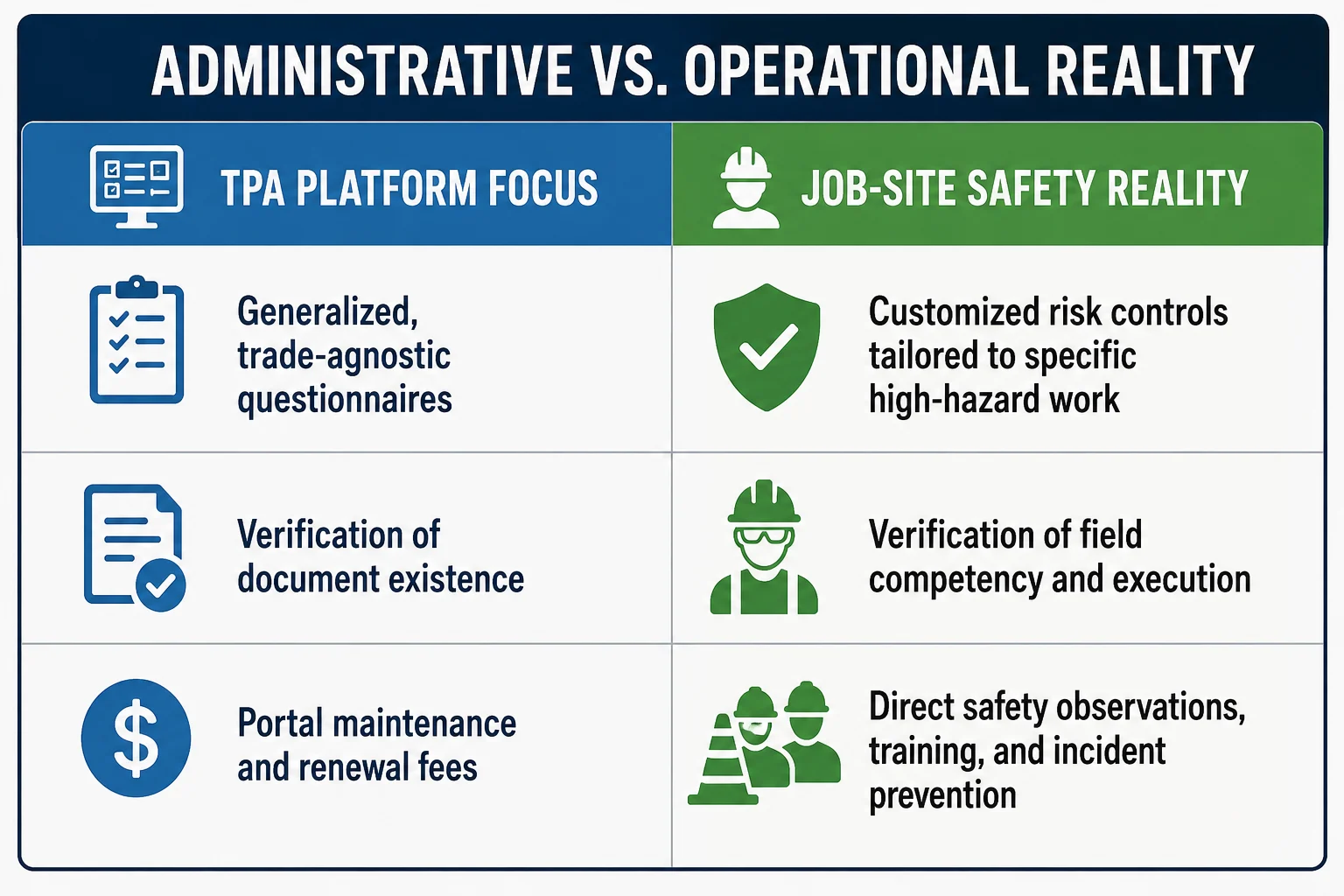
Money is only one component of the supplier burden. Maintaining three separate platforms forces safety managers to spend hours entering the same company data, re-uploading OSHA logs, and filling out redundant, generalized questionnaires.
Every hour a safety manager spends wrestling with TPA administrative portals is an hour not spent conducting field hazard assessments, mentoring workers, or improving actual job-site conditions. While platforms excel at tracking document completion, industry leaders must ask whether standardized, self-reported questionnaires genuinely correlate with lower Total Recordable Incident Rates (TRIR) and Days Away, Restricted, or Transferred (DART) metrics, or simply measure administrative compliance.
Market Structure, Access, and Emerging Alternatives
Rapid M&A and platform aggregation have concentrated significant market share among a few major entities. While consolidation can bring centralized data, high horizontal concentration can also reduce competitive options for hiring clients and create closed environments where contractor data becomes locked within proprietary networks.
In response to platform fatigue, an industry countermovement is taking shape:
- Open Data Standards & Interoperability: Growing demand for standardized safety credentials that can be shared securely across networks rather than re-entered into multiple closed systems.
- Contractor Co-Op Models: Industry associations establishing unified, non-profit prequalification standards to reduce duplicate administrative tasks.
- Direct Enterprise Software: Clients leveraging a modern internal contractor management compliance platform that allows contractors to submit data directly without third-party middleman fees.
Before Selecting a TPA: A Buyer’s Evaluation Framework
Supply chain and EHS executives must evaluate third-party administrators beyond sales pitches and network sizes. Prospective clients should demand clear answers to four critical operational questions before signing a contract:
- Data Ownership and Portability: Does the platform allow open API integration so contractors can seamlessly transfer safety and insurance data, or does it lock vendor data behind a proprietary paywall?
- Fee Structure Transparency: What is the full schedule of direct and indirect fees charged to contractors across all tiers, and are contractors penalized with extra charges for basic support or standard document submissions?
- Safety Customization vs. Template Overhead: Can risk thresholds and questionnaires be strictly tailored to specific trades using customized contractor qualification solutions, or are small, low-risk contractors forced to complete hundreds of irrelevant enterprise questions?
- Validation Quality: Are safety programs and insurance certificates reviewed by certified safety professionals, or outsourced to automated clearinghouses focused solely on document volume?
Realigning Incentives in Contractor Prequalification
There are strong arguments for investment in contractor-management technology. Interoperability could allow suppliers to maintain core information once instead of repeatedly uploading it. Automation and AI could shorten review turnaround times while allowing human specialists to focus on high-risk, complex compliance cases.
Capital could make those improvements possible. But when supplier participation itself is monetized, platform incentives diverge from actual safety outcomes.
Who Ultimately Pays?
The financial burden follows a direct loop:
- Private Equity demands growth and margin expansion from high-valuation portfolio companies.
- TPAs monetize the captive supplier network through mandatory setup fees and recurring tiered subscriptions.
- Contractors pass those compliance overhead expenses directly into their labor rates, burden rates, and job bids.
- Hiring Clients absorb the inflated bid prices, higher project costs, and reduced pool of qualified local subcontractors.
In the end, the hiring client pays twice: once for the software portal, and again through invisible overhead added to every contractor invoice.
Taking Back Control
Hiring clients must take back control of the prequalification model. Rather than defaulting to PE-driven platforms that extract revenue from suppliers, EHS and procurement leaders should demand open API integrations, reasonable contractor fees, trade-specific safety evaluations, and client-focused contractor prequalification. The value of a prequalification system must no longer be judged by valuation multiples or software revenues, but by a much simpler metric: Has managing contractor risk become easier, faster, and safer for the people doing the work?
References
[1] Norwest Venture Partners, 12 Years to Forever: Reflections on Norwest’s Partnership with Supply Chain Safety Leader Avetta; The Wall Street Journal reported Norwest’s original PICS/Avetta investment at approximately $35 million.
[2] The Wall Street Journal, April 2, 2024. WSJ reported Welsh Carson’s 2018 Avetta transaction at roughly $500 million and identified subsequent expansion, including BROWZ.
[3] Blackstone, December 17, 2020, Blackstone Announces Significant Minority Investment in ISN, reporting a valuation of more than $2 billion.
[4] Avetta/EQT announcement and The Wall Street Journal, April 2, 2024. Official financial terms were not disclosed; WSJ reported a valuation exceeding $3 billion including debt.
[5] Thoma Bravo, PEC and Veriforce Merge to Create Comprehensive Supply Chain Safety and Compliance Platform, May 15, 2019; Thoma Bravo identifies 2018 as its investment year.
[6] Veriforce acquisition announcements covering ComplyWorks, ComplyWorks Africa and CHAS.
[7] Thoma Bravo, December 2, 2024. The firm reported sixfold Veriforce revenue growth during its five-year ownership period through organic initiatives and strategic M&A; transaction terms for the sale to Apax were undisclosed.
[8] Avetta, July 19, 2021, announcement confirming completion of the Pegasus acquisition.
[9] ISNetworld’s current contractor/supplier user agreement and pricing disclosures establish the annual-subscription-plus-setup-fee structure and workforce-based pricing.
[10] Public third-party pricing records: 2021 ($750 annual fee); 2022 ($750); 2024 ($800); 2026 starting price approximately $875. These records should be characterized as publicly reported pricing rather than an audited ISN historical price series.
[11] Public discussion among safety professionals provides anecdotal, not statistical evidence of contractor enrollment costs being incorporated into supplier charges.