Written by: CanQualify | Reviewed by: John Carlson BS, MS Integrity Safety | Updated: September 10, 2026
Contractor safety is not separate from an organization’s safety program. When contractors, subcontractors, suppliers, and outsourced service providers perform work on behalf of a company, their safety practices can directly affect workers, operations, regulatory exposure, client relationships, and overall safety performance.
That is one reason ISO 45001 is so relevant to contractor prequalification.
ISO 45001 is the international standard for Occupational Health and Safety Management Systems. It provides a framework for organizations to manage occupational health and safety risks, improve safety performance, and create safer workplaces through leadership commitment, hazard identification, risk assessment, worker participation, operational controls, performance evaluation, and continual improvement.
For companies that rely on third-party labor, ISO 45001 reinforces an important point: contractor work can introduce risks that affect the organization, even when the workers are not directly employed by it.
A contractor may not be your employee, but if that contractor performs work on your site, represents your operation, or creates hazards that can affect your workforce, the organization needs a structured way to evaluate, control, monitor, and document that risk.
That is where contractor prequalification becomes more than an administrative process. Done correctly, it becomes part of the organization’s occupational health and safety management system.
What ISO 45001 Is in Practical Terms
ISO 45001 is designed to help organizations prevent work-related injury and ill health by building a structured Occupational Health and Safety Management System, often called an OH&S management system. The standard applies to organizations of all sizes and industries and is built around a proactive approach to identifying hazards, reducing risks, evaluating performance, and improving over time.
In practical terms, ISO 45001 helps organizations answer questions such as:
- Does the organization understand the hazards associated with its work?
- Are risks evaluated before work begins?
- Are contractor and supplier activities included in the safety management process?
- Are safety expectations documented and communicated?
- Are contractors competent for the work they are performing?
- Are deficiencies identified, corrected, and used to improve the program?
Is the organization maintaining records that can support audits, management reviews, client inquiries, and incident investigations?
For contractor management, the key point is ISO 45001 is not only about internal employees. It also addresses the need to control outsourced processes, procurement activities, and contractor work that may affect OH&S performance.
Why ISO 45001 Matters for Contractor Safety
Many contractor safety failures begin before work starts.
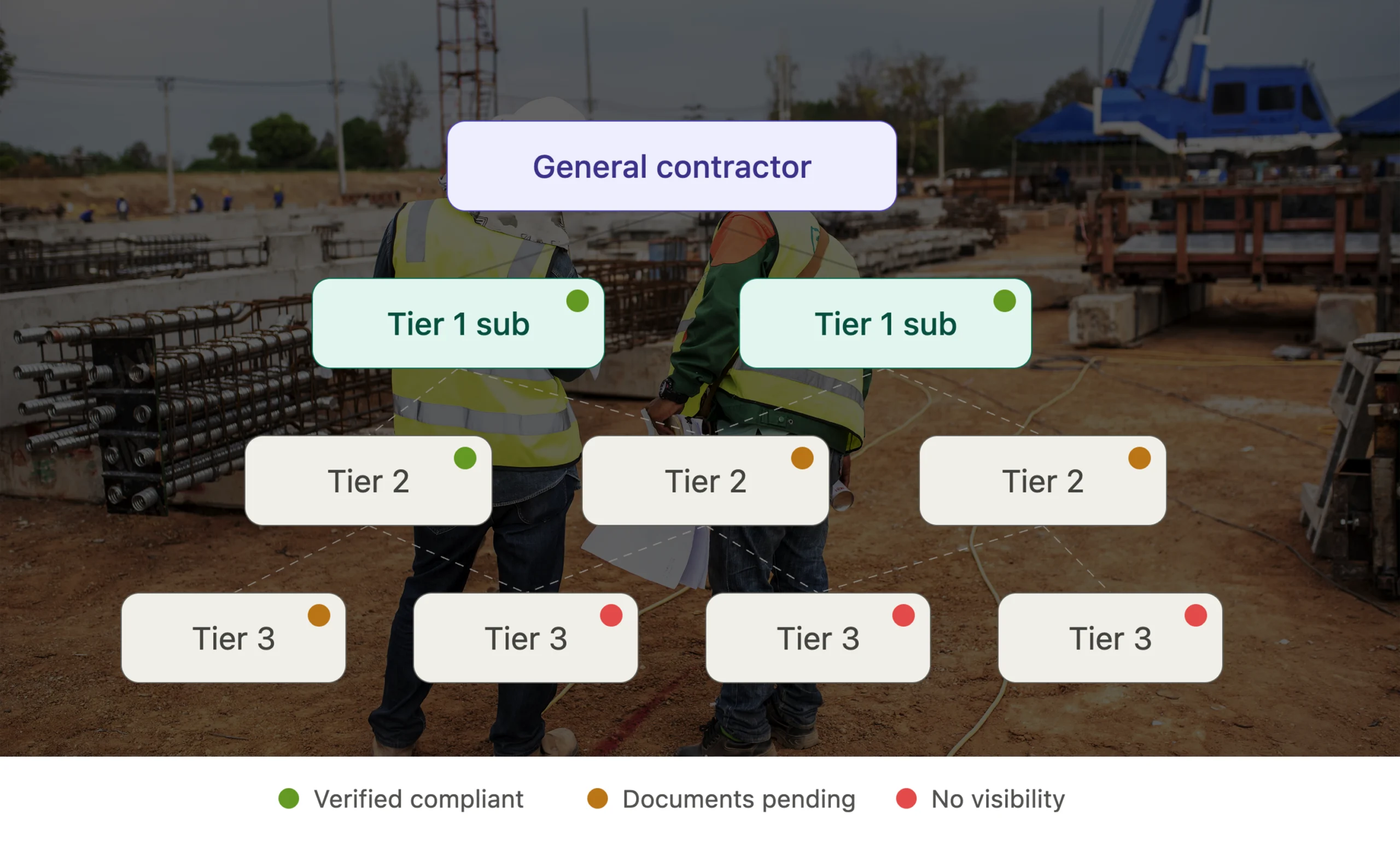
A contractor may be approved without a meaningful review of its safety performance. A safety manual may be collected but never evaluated for relevance. Insurance may be uploaded once and then allowed to expire. Training records may be incomplete, outdated, or disconnected from the actual scope of work. A contractor may appear compliant on paper while still presenting elevated risk in the field.
ISO 45001 helps organizations move beyond basic document collection. It encourages a structured, risk-based approach to contractor safety management. That means identifying contractor-related hazards, evaluating the risk before engagement, applying appropriate controls, monitoring performance, documenting decisions, and correcting deficiencies.
This is especially important for organizations with multiple sites, decentralized operations, high-risk work, or large contractor populations. Without a consistent system, contractor approval can vary by location, department, project manager, or urgency of the job. That inconsistency can create exposure.
OSHA’s recommended practices for safety and health programs also emphasize a proactive approach to managing workplace safety and preventing injuries, illnesses, and deaths. OSHA’s Multi-Employer Citation Policy provides an additional practical reason to understand contractor and subcontractor activities: on multi-employer worksites, more than one employer may be citable for a hazardous condition depending on the facts and the employer’s role as a creating, exposing, correcting, or controlling employer. The policy does not make a hiring organization automatically responsible for every contractor violation, but it reinforces the importance of understanding authority, oversight, and shared workplace safety responsibilities.
ISO 45001 provides a management system framework. Contractor prequalification helps put that framework into practice.
Key ISO 45001 Contractor Management Requirements
Several ISO 45001 requirements are especially relevant to contractor safety, supplier safety compliance, and outsourced process control.
Contractor Risk Identification
Organizations need to identify occupational health and safety risks that can affect their operations, including risks introduced by contractors and suppliers. This means contractor risk should be evaluated before the contractor begins work, not after an incident, audit, or client concern.
A practical contractor review may include safety performance history, OSHA logs or incident data, EMR, written safety programs, training records, insurance coverage, licenses, certifications, and scope-specific qualifications.
Competence, Training, and Awareness
ISO 45001 places strong emphasis on worker competence. For contractor safety, that means organizations should be able to determine whether contractor personnel are qualified for the work they are assigned to perform.
This is a common gap. Many companies approve the contractor company but do not consistently validate whether the individual employees assigned to the job have the right training, credentials, certifications, licenses, or site-specific acknowledgements.

Control of Procurement and Contractors
ISO 45001 expects procurement and contractor-related processes to support occupational health and safety performance. In other words, contractor selection should not be based only on price, availability, or speed.
Safety risk belongs in the procurement and onboarding decision.
That requires defined contractor requirements, documented approval criteria, risk-based review standards, and a process for managing deficiencies.
Control of Outsourced Processes
Outsourced work can still create occupational health and safety risk. ISO 45001 expects organizations to control outsourced processes that may affect OH&S performance.
For contractor management, this means organizations should understand what work is being outsourced, what hazards may be introduced, what controls are required, who is responsible for oversight, and how compliance will be documented.
Monitoring, Measurement, and Continual Improvement
A contractor’s safety status is not permanent. Insurance can expire. Training can lapse. Safety performance can change. Ownership, staffing, scope of work, and regulatory history can change as well.
ISO 45001 supports a continuous model: monitor, measure, evaluate, correct, and improve.
That is why annual requalification, ongoing compliance monitoring, corrective action tracking, and management review are important parts of a mature contractor safety program.
ISO 45001 Clause Mapping for Contractor Prequalification
The following table translates selected ISO 45001 concepts into practical contractor-management applications. It is an interpretive mapping – not a verbatim statement of the standard and not a substitute for ISO 45001, certification guidance, or professional advice. Clauses 8.1.4, 8.1.4.2, and 8.1.4.3 provide the clearest direct connection to procurement, contractors, and outsourcing; other rows show how broader OH&S management-system concepts can reasonably be applied to contractor prequalification and oversight.
ISO 45001 Contractor-Management Alignment
A practical mapping of ISO 45001 concepts to contractor-management activities and how CanQualify supports the process.
| ISO 45001 Area | Practical Contractor-Management Application | How CanQualify Supports the Process |
|---|---|---|
| Foundation & Risk Planning | ||
| Clause 4 — Context of the Organization | Consider contractor, supplier, and outsourced-work risks that may affect OH&S performance. | Helps identify and document risks introduced through third-party work. |
| Clause 5 — Leadership and Commitment | Establish oversight and accountability for contractor activities within the OH&S system. | Provides visibility into contractor review status, compliance, and reporting. |
| Clause 6.1 — Risks and Opportunities | Consider contractor-related risks before work begins. | Supports risk-based review using safety data, documentation, insurance, training, and scope-relevant requirements. |
| Clause 6.1.2 — Hazard Identification and Risk Assessment | Identify hazards and assess OH&S risks associated with contractor work. | Helps determine whether contractor programs and qualifications align with the hazards and work performed. |
| Clause 7.2 — Competence | Ensure contractor personnel are competent for assigned work where applicable. | Tracks worker-level training, credentials, certifications, licenses, and qualifications. |
| Clause 7.5 — Documented Information | Maintain current and accessible OH&S documentation. | Centralizes contractor documentation, status, expirations, and audit-ready records. |
| Operational Control | ||
| Clause 8.1 — Operational Planning and Control | Establish appropriate criteria and controls before work is performed. | Supports prequalification thresholds, approval criteria, and contractor status workflows. |
| Clause 8.1.4 — Procurement | Incorporate OH&S considerations into procurement processes. | Helps integrate safety requirements into contractor selection and onboarding. |
| Clause 8.1.4.2 — Contractors | Coordinate contractor procurement activities and address associated OH&S risks. | Supports contractor prequalification, monitoring, requalification, and ongoing oversight. |
| Clause 8.1.4.3 — Outsourcing | Control outsourced functions that can affect OH&S performance. | Provides a structured process for documenting contractor and supplier compliance associated with outsourced work. |
| Performance & Improvement | ||
| Clause 9.1 — Monitoring, Measurement, Analysis and Evaluation | Determine what should be monitored to understand OH&S performance and management-system effectiveness. | Tracks contractor status, missing requirements, expirations, safety indicators, and recurring deficiencies. |
| Clause 9.2 — Internal Audit | Evaluate whether contractor-related OH&S processes are effectively implemented. | Provides contractor records, reports, and documentation supporting internal audit preparation. |
| Clause 9.3 — Management Review | Give leadership visibility into OH&S performance, trends, risks, and improvement opportunities. | Provides reporting on contractor risk, compliance status, and trends. |
| Clause 10.2 — Incident, Nonconformity and Corrective Action | Address nonconformities, implement corrective action, and determine whether further action is needed. | Supports documentation of contractor gaps, corrective actions, and requalification needs. |
| Clause 10.3 — Continual Improvement | Improve OH&S management-system effectiveness over time. | Requalification, monitoring, and trend visibility help strengthen contractor-management controls over time. |
This mapping is intended as a practical contractor-management reference and is not a substitute for ISO 45001 certification guidance.
This mapping is valuable because it shows contractor prequalification as part of a broader safety management system, not as a standalone paperwork requirement.
The objective should be predictable enforcement rather than surprise enforcement.
Contractors are more likely to respond effectively when they understand what is expiring, what is required, and how to resolve the issue.
Common Contractor Safety Gaps ISO 45001 Helps Address
ISO 45001 is useful because it directs organizations to examine whether safety controls function in practice – not merely whether documents exist. For contractor management, that exposes several common gaps:
- Contractors approved without a structured safety review
- Safety manuals collected but not evaluated for scope relevance
- Training records missing, expired, or not tied to assigned work
- Insurance certificates collected once but not actively monitored
- Contractor requirements applied inconsistently across sites or business units
- Procurement decisions made without meaningful safety input
- Outsourced work excluded from the formal safety management system
- Expired documents left unresolved
- No clear record showing why a contractor was approved
- No process for corrective action, requalification, or escalation.
These are also among the most common reasons contractor compliance programs fail even when formal policies are already in place.
These gaps matter because they weaken defensibility. After a serious incident, client audit, OSHA inquiry, insurance review, or legal dispute, the question is rarely, “Did the contractor upload a document?”
The better question is, “Did the organization have a reasonable, consistent, documented process for identifying and controlling contractor risk?”
That is where ISO 45001 and contractor prequalification intersect.
The Difference Between Collecting Documents and Controlling Risk
One of the most important distinctions in contractor management is the difference between collecting information and validating information.
Collecting a safety manual does not prove the manual applies to the contractor’s scope of work.
Collecting OSHA data does not automatically explain whether the contractor’s safety performance is acceptable.
Collecting a certificate of insurance does not mean coverage meets client requirements or remains active over time.
Collecting training records does not confirm that the right workers are qualified for the right job.
ISO 45001 points organizations toward control, evaluation, monitoring, and improvement. That requires more than storage. It requires a process that helps determine whether contractor information is complete, current, relevant, and aligned with the organization’s requirements.
This is why contractor prequalification should be viewed as a safety risk management function, not a clerical task.
Benefits of Applying ISO 45001 Principles to Contractor Safety
Applying ISO 45001 principles to contractor management can improve visibility, consistency, audit readiness, accountability, and corrective action.
Stronger Risk Visibility
A structured process gives safety, procurement, operations, and leadership better visibility into contractor risk before work begins by connecting safety performance, written programs, insurance, workforce qualifications, and compliance status.
More Consistent Contractor Approval Decisions
Defined processes and documented controls help keep contractor approval consistent across sites, departments, and business units.
If one location enforces contractor requirements and another treats them as optional, the organization’s program becomes harder to manage and harder to defend.
Better Audit Readiness
Current, organized contractor records can support internal audits, client reviews, insurance reviews, OSHA or MSHA inquiries, and post-incident investigations.
Improved Contractor Accountability
When expectations are clearly defined and consistently applied, contractors better understand what is required before work begins. This helps reduce confusion, missed requirements, and last-minute compliance issues.
Stronger Safety Culture Across the Extended Workforce
Contractors often work alongside employees, share work areas, and influence site-level safety behavior. When contractor safety expectations are clear, consistent, and monitored, the organization strengthens safety culture across the extended workforce.
Better Corrective Action and Continual Improvement
A mature contractor safety program does not simply approve or reject contractors. It identifies deficiencies, communicates expectations, tracks corrective action, and uses data to improve future decisions.
That is directly aligned with the continual improvement model behind ISO 45001.
How CanQualify Supports ISO 45001-Aligned Contractor Safety Management
CanQualify does not certify an organization to ISO 45001. Certification requires a formal management system and an accredited certification process.
CanQualify helps organizations operationalize contractor-related elements of an ISO 45001-aligned safety management system through structured prequalification, validation, monitoring, requalification, and audit support. The objective is not simply to store contractor records, but to create a consistent process for making and documenting contractor qualification decisions.
DocuQual: Organizing Contractor Documentation
DocuQual establishes the documentation foundation of contractor prequalification by collecting contractor questionnaires, company information, required documents, and scope-relevant submissions in a centralized process. This supports consistency and documented information while reducing reliance on scattered emails and spreadsheets.
SafetyQual: Validating Contractor Safety Performance
SafetyQual supports safety-risk evaluation by validating contractor information such as OSHA data, EMR, incident history, safety statistics, and related performance indicators against defined requirements. This connects prequalification to risk assessment, performance evaluation, and ongoing contractor oversight.
InsureQual: Monitoring Insurance Compliance
InsureQual monitors certificates of insurance against client requirements and tracks expirations or changes so insurance documentation is not collected once and forgotten.
EmployeeQual: Tracking Worker-Level Competence
EmployeeQual supports worker-level competence by tracking training, certifications, licenses, orientations, acknowledgements, and other credentials relevant to assigned work.
AuditQual: Strengthening Program Review and Defensible Oversight
AuditQual supports deeper review when an organization needs evidence that contractor safety programs are not only submitted, but relevant to the work and capable of being implemented.
Safety Manual Audits evaluate whether written programs are relevant to the contractor’s scope of work, while Implementation Audits examine whether those programs are being applied in practice. These reviews support audit readiness, corrective action, and continual improvement.
Practical Example: Why Scope-Specific Review Matters
Consider a contractor hired for confined space entry, hot work, electrical work, or work at height.
A basic company profile and insurance certificate are not enough. The hiring organization should understand whether the contractor has relevant written programs, trained personnel, current certifications, appropriate insurance, acceptable safety performance, and a process for correcting deficiencies.
A generic safety manual may look complete, but it may not address the scope and hazards of the actual work. A contractor may have good company-level safety statistics but still assign workers without the required task-specific credentials. A certificate of insurance may be current when uploaded but expire before the project is complete.
This is the kind of gap ISO 45001 is designed to help organizations control.
Practical point: contractor approval should follow the risk of the work, not simply the identity of the company. A contractor can meet general qualification requirements and still lack the written program, training, or credentials needed for a specific high-risk task.
Contractor prequalification, when properly structured, helps identify these issues before work begins.

Practical Steps to Operationalize ISO 45001 for Contractors
Organizations can strengthen ISO 45001 contractor management alignment by following a practical sequence.
1. Define Contractor Risk Categories
Not every contractor creates the same level of risk. Organizations should categorize contractors based on work scope, exposure level, trade, location, regulatory requirements, and operational impact.
High-risk work should receive a more detailed review than low-risk services.
2. Establish Clear Prequalification Requirements
Requirements should be defined before contractors are onboarded. These may include safety manuals, OSHA logs, EMR, incident rates, insurance coverage, training records, certifications, licenses, financial documentation where applicable, and client-specific requirements.
3. Evaluate Contractors Before Work Begins
Prequalification should occur before contractor engagement, not after mobilization. Once a contractor is already on-site, safety teams often lose leverage and deficiencies become harder to correct.
4. Validate Information for Relevance
Submitted documents should be reviewed for completeness, accuracy, currency, and relevance to the scope of work. A document should not be accepted simply because it was uploaded.
5. Track Worker-Level Qualifications
Where applicable, organizations should confirm that contractor employees have the training, credentials, and acknowledgements required for their assigned work.
6. Monitor Compliance Over Time
Insurance, training, safety performance, and documentation can change. Contractor compliance should be actively monitored through expiration tracking, requalification, and status reporting.
7. Document Deficiencies and Corrective Actions
When gaps are identified, the organization should document the deficiency, communicate the requirement, track corrective action, and maintain evidence of resolution.
8. Use Contractor Data in Management Review
Leadership should have visibility into contractor compliance status, recurring deficiencies, risk trends, and improvement opportunities. This helps contractor management become part of the broader OH&S management system.
ISO 45001 Makes Contractor Safety More Defensible
A contractor safety program should be able to withstand scrutiny.
If an incident occurs, if a client asks for evidence, if an auditor reviews the program, or if regulators examine contractor oversight, the organization needs more than a list of uploaded files. It needs to show that it had a reasonable process for identifying risks, applying controls, communicating expectations, monitoring compliance, and addressing deficiencies.
That is where ISO 45001 creates value. It gives organizations a framework for managing occupational health and safety risk. Contractor prequalification helps apply that framework to third-party work.
A defensible process connects work scope to risk, applies defined requirements, validates evidence, monitors changes, and documents how deficiencies are resolved.
Conclusion
For organizations that rely on contractors, suppliers, subcontractors, and outsourced service providers, ISO 45001 provides a practical framework for integrating third-party work into the broader OH&S management system.
For contractor management, the practical sequence is straightforward: identify risk, evaluate competence, apply procurement and operational controls, maintain documented information, monitor performance, correct deficiencies, and improve over time.
CanQualify helps operationalize that sequence through structured prequalification, safety validation, compliance monitoring, worker-level qualification tracking, and audit support.
ISO 45001 provides the framework. CanQualify helps make contractor safety oversight operational, visible, and defensible.