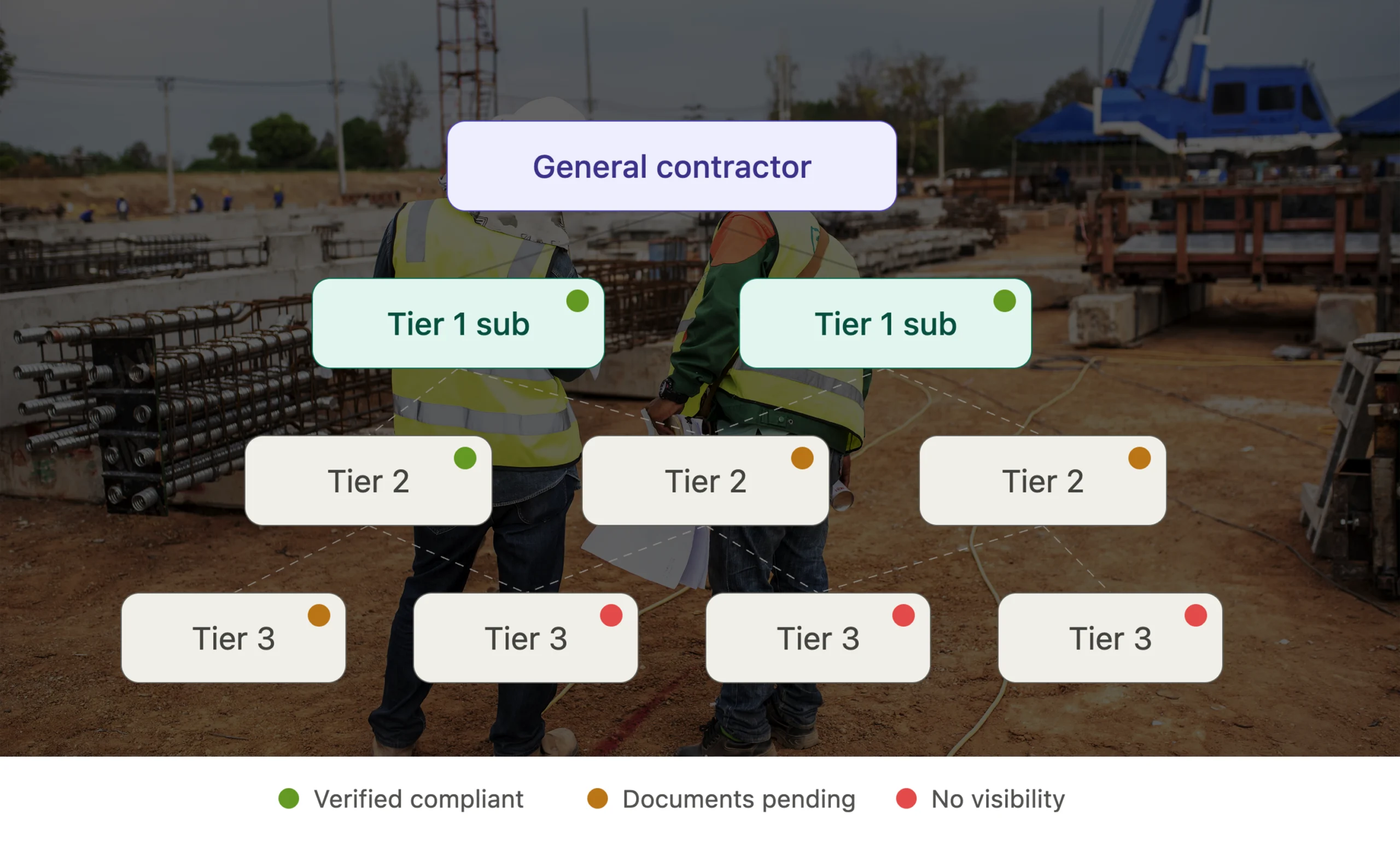
A general contractor may be fully qualified to work at your facility, but what about the subcontractors working under them?
Consider a manufacturing plant preparing for a scheduled shutdown. The general contractor has completed prequalification, submitted the required insurance, and met the facility’s safety standards. As the project approaches, the GC brings in a specialty subcontractor to complete part of the work.
The subcontractor may be experienced and qualified, but has anyone evaluated the company against the facility’s requirements? Are its workers properly trained for their assigned tasks? Does the facility even know the subcontractor will be onsite?
These are practical questions that can be overlooked when the focus remains on the company holding the primary contract.
Effective subcontractor management starts with knowing which companies are performing the work, holding them to consistent qualification standards, and maintaining visibility across every contracting tier.
The goal isn’t to create another layer of paperwork. It’s to establish a process that helps general contractors, subcontractors, and hiring organizations manage their responsibilities without unnecessary confusion or delays.
What is Subcontractor Management?
Subcontractor management is the process of identifying, qualifying, coordinating, and overseeing companies hired by another contractor to perform work.
A hiring organization may contract directly with a general contractor or prime contractor. That company may hire subcontractors for specialized work, and those subcontractors may bring in additional companies.
For the hiring organization, the important question isn’t simply whether the general contractor is approved. It’s whether the other companies performing work have also met the applicable requirements.
A well-managed program should establish:
- Which subcontractors are performing work and who hired them
- Whether each company meets the hiring organization’s qualification standards
- How subcontractors are associated with their general contractors
- Who is responsible for communicating and maintaining compliance requirements
- How worker qualifications, site access, and ongoing oversight are addressed
These expectations create a consistent approach without unnecessarily duplicating administrative work.
Why Subcontractor Visibility Matters?

A hiring organization may have a well-established process for qualifying its general contractors while having limited visibility into the subcontractors those companies hire.
During a scheduled facility shutdown, for example, an approved general contractor may engage separate subcontractors for electrical work, equipment installation, and rigging. Each company brings its own employees, insurance coverage, safety programs, and qualifications.
If the facility’s compliance records identify only the general contractor, the hiring organization may not have sufficient information to determine whether each subcontractor meets its applicable requirements.
This becomes a problem when a subcontractor arrives ready to begin work, but its qualification status has not been established. Operations is focused on maintaining the project schedule, Safety needs to address outstanding requirements, and the general contractor may believe its own approval is sufficient.
These situations can create unnecessary delays and pressure to make qualification decisions after crews have already mobilized.
Effective subcontractor visibility means identifying the companies expected to perform work, understanding their relationship with the general contractor, and establishing how their qualifications will be evaluated before work begins.
The objective is not to duplicate the general contractor’s responsibilities, but to ensure the hiring organization has reliable information about the companies performing work and whether its requirements have been satisfied.
Establish One Prequalification Standard Across Contracting Tiers
One of the most important subcontractor management best practices is applying a consistent qualification process to the companies performing work.
A general contractor’s approval should not automatically extend to its subcontractors.
For covered work, each subcontractor should complete the hiring organization’s established prequalification process and maintain its own qualification record.
This doesn’t mean every contractor must submit identical documentation.
An electrical subcontractor performing energized work may need different safety programs, training, and credentials than a contractor providing routine cleaning services.
The hiring organization’s qualification framework should establish a common baseline while applying additional requirements according to the work being performed and the associated risks.
Depending on the scope, subcontractor prequalification may include:
- Company safety performance and applicable regulatory history
- Written safety programs relevant to the work
- Insurance coverage and contractual requirements
- Trade licenses and specialized qualifications
- Employee training and certifications
- Project-specific safety requirements
The important distinction is that every applicable company follows the same qualification framework, even when the specific requirements differ by work scope.
This helps avoid a situation where one subcontractor completes prequalification while another is permitted to work simply because it was hired through a different general contractor.
Connect Every Subcontractor to its General Contractor
Prequalifying subcontractors individually is important, but the hiring organization also needs to understand how those companies are connected.
A general contractor may manage several subcontractors on a project. Some may work for multiple general contractors, while others may bring in additional companies for specialized work.
Without a reliable way to identify these relationships, qualification information can become disconnected from the actual project.
A centralized subcontractor management process should allow the hiring organization to identify:
- The general contractor responsible for the subcontractor
- The subcontractor’s individual qualification status
- Work or project associated with the relationship
- Any additional subcontracting tiers
- Outstanding qualification requirements or deficiencies
This gives the hiring organization a more complete picture of the contractor population without requiring it to manage every subcontractor’s daily activities.
It also allows general contractors to maintain visibility into the companies working under them.
The subcontractor’s qualification record should remain associated with the company itself, while its relationship with a particular general contractor or project can be established separately.
That distinction becomes useful when a subcontractor works for multiple general contractors or returns for another project.
The process should also account for any additional subcontractors brought onto a project, including companies hired by an existing subcontractor when those arrangements are permitted.
Regardless of the contracting relationship, companies performing covered work should be identified and meet the hiring organization’s applicable prequalification requirements before beginning work.
How Software Systems Map Parent-Child Subcontractor Relationships
Managing sub-tier contractors requires a compliance system capable of handling complex parent-child database relationships. A subcontractor may work for multiple general contractors across different facility locations or even serve as a primary contractor on separate jobs.
Centralized compliance software resolves this complexity by decoupling company-level qualification from project-level assignments:
- Universal Company Profile (Parent Record): A subcontractor completes company-level prequalification once – submitting EMR, OSHA logs, written programs, and corporate insurance. This baseline status is maintained in a central company profile.
- Project & GC Linkage (Child Record): When a GC proposes using that subcontractor for a specific project, the platform links the subcontractor’s active profile to the GC’s project account.
- Scope-Specific Requirements: If the specific project scope requires higher insurance limits or specialized trade credentials, those are validated at the relationship level without forcing the subcontractor to re-submit baseline company documents.
This entity-mapping structure gives hiring clients full visibility into multi-tier contractor relationships while saving subcontractors from redundant registrations and duplicate document submissions.

Subcontractor Approval Should Not Depend on the Contracting Tier
A contractor that does not meet the hiring organization’s safety requirements should not become acceptable simply because it is hired as a subcontractor.
Consider a company that exceeds a client’s established safety performance thresholds and is therefore not approved to perform certain work.
If that same company is later proposed as a subcontractor under an approved general contractor, its safety performance hasn’t changed.
Neither should the qualification decision, unless the hiring organization conducts an authorized review and determines that an exception or different scope-based evaluation is appropriate.
CanQualify encountered this type of situation in its case study, How Subcontractor Prequalification Requirements Prevented Elevated Risk.
The example illustrates why consistent qualification requirements matter. A change in contracting relationships should not become a way to bypass the hiring client’s established safety standards.
A reliable program evaluates the company performing the work, regardless of where it falls in the contracting structure.
Define Responsibilities Between Hiring Clients and General Contractors
A consistent qualification process still requires clear responsibilities.
The hiring organization establishes its contractor compliance standards and determines how qualification decisions, deficiencies, and exceptions are handled.
The general contractor coordinates its subcontractors, communicates project requirements, and ensures the companies it intends to use complete the established process.
Each subcontractor remains responsible for its own employees, safe work practices, and applicable regulatory obligations.
The hiring organization may use an internal team or a third-party prequalification provider to collect and validate information. General contractors may also assist with administration and communication.
However, delegating those tasks should not eliminate the hiring client’s visibility into qualification status or create a separate approval standard.
For example, a facility may require its general contractors to identify subcontractors during project planning and confirm that each company has completed the client’s prequalification requirements before mobilization.
The general contractor can then coordinate the work while the hiring organization maintains visibility into which companies are approved.
OSHA’s Recommended Practices for Safety and Health Programs in Construction emphasize communication and coordination among general contractors, subcontractors, and other employers sharing a worksite.
These principles support a practical approach: establish responsibilities before work begins, communicate hazards, and coordinate the activities of the companies involved.
Enforce Subcontractor Standards Through Contractual Flow-Down Clauses
Establishing compliance expectations is ineffective if they are not legally binding across every tier of the project. Hiring organizations must enforce subcontractor standards using two critical contractual mechanisms:
- Mandatory Flow-Down Provisions: Master agreements with general contractors must include flow-down clauses that require GCs to contractually bind every sub-tier contractor to the primary facility’s safety, insurance, and compliance standards. This prevents GCs from substituting lower standards for their own subcontracts.
- Subcontractor Disclosure Requirements: GCs should be contractually obligated to disclose every sub-tier entity to the hiring client prior to mobilization. Unannounced subcontractors should be strictly prohibited from entering the jobsite until their disclosure and qualification status are validated.
By establishing mandatory flow-down terms and disclosure requirements during pre-construction planning, hiring organizations ensure compliance expectations are established before crews arrive on site.
Company Approval is Not the Same as Worker Authorization
Subcontractor oversight requires separating three distinct levels of compliance: company prequalification, worker qualification, and site access authorization. Completing one step does not automatically satisfy the others.
For example, an electrical subcontractor may meet all company-level insurance and safety standards, but that does not mean every assigned employee holds the required trade certifications or site-specific orientation.
| Oversight Level | What It Validates | Primary Artifacts & Records | Responsible Parties |
|---|---|---|---|
| Company Prequalification | Corporate safety performance, financial stability, insurance coverage, and written safety programs. | EMR, OSHA 300 logs, Certificates of Insurance (COI), written safety manuals. | Hiring Client / Prequalification Provider |
| Worker Qualification | Individual trade competency, specialized skill training, and task-specific credentials. | Trade licenses, OSHA 10/30 cards, equipment certifications, training records. | Subcontractor Employer / General Contractor |
| Site Access & Work Authorization | Operational permission to physically enter the facility and execute specific scopes under site procedures. | Site orientation completion, security badges, daily rosters, work permits. | Facility Operations / Site Safety Personnel |
These distinctions become critical when subcontractors swap crew members or add workers mid-project. A practical compliance program connects company-level records with worker credentials and facility access controls, so site teams maintain full visibility without creating administrative bottlenecks.
Know Which Workers are on Your Jobsite
Knowing which subcontractor companies are approved is important. Knowing which workers are present is a separate responsibility.
A facility may have complete qualification records for its general contractor while still lacking current information about the subcontractors and employees assigned to a particular project.
This matters when crews change, additional subcontractors are brought in, or multiple employers are working in the same area.
When a mechanical subcontractor replaces two employees midway through a project, the company’s qualification status may remain unchanged. However, the replacement workers may still need to complete site-specific orientation or provide credentials required for their assigned work.
Without a process for identifying those changes, the facility may not know that different employees are now performing the work.
Worker visibility also matters when an incident occurs. Site personnel need to know which employers are involved so they can coordinate the response, communicate with the appropriate supervisors, and address related hazards.
Depending on the operation, organizations may use worker rosters, training and certification records, digital credentials, site orientation records, or access-control procedures.
These systems serve related purposes, but they are not interchangeable.
A prequalification platform can help maintain company and worker qualification information. Knowing who is physically onsite at any given moment requires a reliable attendance or access-control process.
The objective is to connect these processes so site personnel have dependable information without creating unnecessary administrative work.
Keep Subcontractor Compliance Current Throughout the Project
Prequalification establishes whether a subcontractor meets the applicable requirements at the time of review. Those requirements still need attention as work continues.
Insurance policies expire. Training credentials may require renewal. Workers change. Subcontractors may be assigned additional work outside their original scope.
A well-managed program identifies which changes require additional review and who is responsible for responding.
For example, if a subcontractor’s insurance is approaching expiration, the contractor should receive notice so updated information can be provided before the deficiency affects its approval status.
If a subcontractor takes on a new scope involving higher-risk activities, the facility may need to evaluate additional safety programs or worker qualifications.
Not every change requires restarting the entire qualification process.
The important point is to identify which changes matter and address them before they create problems for the project.
Centralized qualification records and ongoing monitoring can help. When relevant information is available to the people responsible for the work, issues can often be resolved before they reach the site.
Make Subcontractor Compliance part of Project Planning

Contractor compliance works better when it is part of normal project planning rather than something addressed after a crew arrives.
General contractors should understand the hiring organization’s subcontractor requirements before selecting and scheduling companies.
Project managers should know which subcontractors are expected to participate and whether their qualification requirements have been completed.
Safety and procurement teams should have enough visibility to identify outstanding issues before mobilization.
This doesn’t mean every department needs to review the same information or approve the same documents.
It means each group understands its role and knows where to find the information it needs.
The goal is to identify the specialty subcontractor early enough so that its qualification requirements can be addressed without delaying the project.
Subcontractors should not begin covered work until the applicable qualification and approval requirements have been completed.
If a deficiency is identified, the contractor should understand what needs to be corrected and who is responsible for reviewing the information.
When an exception is appropriate, the process should identify the outstanding requirement, associated risk, any temporary controls, and the person authorized to approve the decision.
Exceptions should be documented and managed according to the hiring organization’s established standards. Some deficiencies may not be suitable for an exception at all.
The objective is to support project schedules without treating safety and compliance requirements as optional.
Prequalification Is Not Field Immunity
Company-level prequalification validates a subcontractor’s safety record and insurance to grant site eligibility, but it does not guarantee safe execution in the field. Active field safety oversight – including daily hazard communication, work coordination, and ongoing jobsite audits – remains essential once work begins.
For a broader look at how prequalification, ongoing monitoring, and field oversight work together, see our guide to Contractor Compliance Best Practices.
Reduce Administrative Burden Without Lowering Standards
There is another side to subcontractor management that deserves attention: the administrative work required by contractors themselves.
General contractors may manage dozens of subcontractors across different projects and hiring clients. Many subcontractors are small businesses without dedicated compliance personnel.
Repeated document requests, multiple registrations, and inconsistent qualification procedures can consume time without necessarily improving the quality of the information being reviewed.
A practical approach is to establish clear requirements, maintain accurate qualification records, and allow existing information to be used when it meets the hiring client’s standards.
This is an important distinction.
Every applicable subcontractor should complete the required qualification process, but that doesn’t necessarily mean every company should start from scratch for each new client.
For example, a subcontractor may already have validated safety and insurance information available through an established prequalification provider.
If the hiring client accepts that provider’s information and the subcontractor meets the client’s requirements, the existing records may support the qualification decision without requiring another unnecessary registration or duplicate document collection.
The client still controls its standards and approval decisions.
CanQualify discusses this approach in How Subcontractor Prequalification Can Help Contractors Win More Work, where existing qualification reports helped demonstrate subcontractor readiness without requiring another platform enrollment.
The objective is to maintain consistent oversight while making the process practical for the companies doing the work.
How CanQualify Supports Multi-Tier Subcontractor Management
CanQualify helps hiring organizations and general contractors manage subcontractor qualification requirements through configurable prequalification programs, safety data validation, insurance monitoring, and centralized qualification information.
Its GC-Client account structure allows participating general contractors to manage associated subcontractors while providing the hiring client with visibility into the qualification status of both the GC and its subcontractors.
Each participating company maintains its own qualification information, while the association between the general contractor and subcontractor helps identify the contracting relationship.
CanQualify also provides hands-on support to help contractors understand requirements, address documentation deficiencies, and maintain current qualification information.
The hiring organization retains authority over its compliance standards, approval decisions, exceptions, and site access requirements.
The goal is to support a consistent subcontractor qualification process while making it easier for general contractors and hiring clients to manage the companies performing work.
Effective Subcontractor Management Starts with Knowing Who is Doing the Work
Effective subcontractor management does not require hiring organizations to take over the general contractor’s responsibilities. It requires a clear understanding of who is performing the work, how qualification decisions are managed, and where accountability rests.
When those expectations are established before mobilization, hiring organizations can maintain appropriate oversight without creating unnecessary administrative burdens for general contractors or their subcontractors.
Frequently Asked Questions About Subcontractor Management
Should every subcontractor complete prequalification?
For an enterprise program requiring prequalification for covered work, every subcontractor performing that work should complete the hiring organization’s applicable qualification process, regardless of its contracting tier.
The specific requirements may vary based on work scope and risk, but subcontractors should not be excluded simply because they were hired through a general contractor.
This is a recommended program standard, not a universal OSHA requirement for third-party prequalification.
Can a general contractor’s approval cover its subcontractors?
A general contractor’s approval should not automatically establish that its subcontractors meet the hiring client’s requirements.
Each subcontractor should have its own qualification record and be evaluated against the applicable standards.
The general contractor can coordinate the process, but its approval does not replace the subcontractor’s qualification.
Who is responsible for subcontractor safety?
Each subcontractor is responsible for meeting its own applicable safety obligations. General contractors and hiring organizations may also have responsibilities depending on their worksite roles, actual control over working conditions, and applicable regulations.
OSHA’s Multi-Employer Citation Policy recognizes that more than one employer may be cited for hazardous conditions at a shared worksite. OSHA evaluates employers based on their roles in creating, exposing employees to, correcting, or controlling hazardous conditions.
OSHA categorizes employers into four distinct roles:
- Creating Employer: The contractor that creates the hazard.
- Exposing Employer: The employer whose own employees are exposed to hazards.
- Correcting Employer: The employer responsible for installing or maintaining safety controls (e.g., scaffolding or guardrails).
- Controlling Employer*: The employer with general supervisory authority over the worksite, including the power to correct safety violations or compel others to fix them.
*The Controlling Employer Risk: Hiring clients often risk inadvertently becoming a “Controlling Employer” if facility managers directly supervise subcontractor crews or dictate day-to-day field operations. To manage risk properly, hiring clients should enforce compliance contractually through the General Contractor, requiring the GC to act as the controlling entity, rather than directly managing sub-tier daily activities in the field.
What happens when a general contractor brings an unapproved subcontractor onsite?
The subcontractor should not begin work requiring prior approval until the applicable requirements have been satisfied or an authorized exception has been granted.
The appropriate response depends on the outstanding requirements and the hiring organization’s procedures.
A defined process helps site personnel address the situation consistently rather than making an informal decision under schedule pressure.
Do subcontractors hired for a single project need prequalification?
When the work falls within the hiring organization’s prequalification requirements, the subcontractor should complete the applicable process even if the assignment is short.
A short project duration does not automatically eliminate the need to evaluate safety, insurance, or worker qualifications.
However, the requirements should remain appropriate to the work being performed.
Do subcontractors need the same insurance coverage as general contractors?
Not necessarily. Coverage types, limits, and endorsements may differ based on the subcontractor’s operations, contractual responsibilities, and associated risks.
The hiring organization should establish applicable insurance requirements and apply them consistently to companies performing comparable work.
How can a hiring organization know which subcontractor employees are onsite?
Organizations may use worker rosters, digital credentials, orientation records, badging, and access-control procedures to identify workers and their associated employers.
Qualification records help establish whether workers meet applicable requirements. Accurate real-time attendance requires a reliable check-in, access-control, or personnel accountability process.
Can existing prequalification reports be accepted instead of requiring another platform registration?
Yes, when the hiring organization accepts the existing information and determines that it satisfies its qualification requirements.
The important distinction is between completing the required qualification process and being required to register with a particular software provider.
An organization can maintain consistent qualification standards while accepting suitable, current, validated information from an existing provider.
Does subcontractor prequalification guarantee a safe jobsite?
No. Prequalification helps organizations evaluate company qualifications and establish requirements before work begins.
Safe operations also depend on competent workers, appropriate hazard controls, supervision, communication, and ongoing field oversight. Prequalification supports those activities but does not replace them.
Know Who’s Working Under Your General Contractors
Prequalifying your general contractors is only part of the process. CanQualify helps you manage subcontractor qualifications, maintain visibility into GC-subcontractor relationships, and apply consistent compliance requirements across your contractor population.