
Contractor insurance requirements are often treated as a paperwork step: request a certificate of insurance (COI), confirm that one arrived, and move the contractor forward. That approach can miss the issue the requirement was meant to address. Does the contractor carry the coverage the contract calls for, for the work it will actually perform, during the time it will perform it?
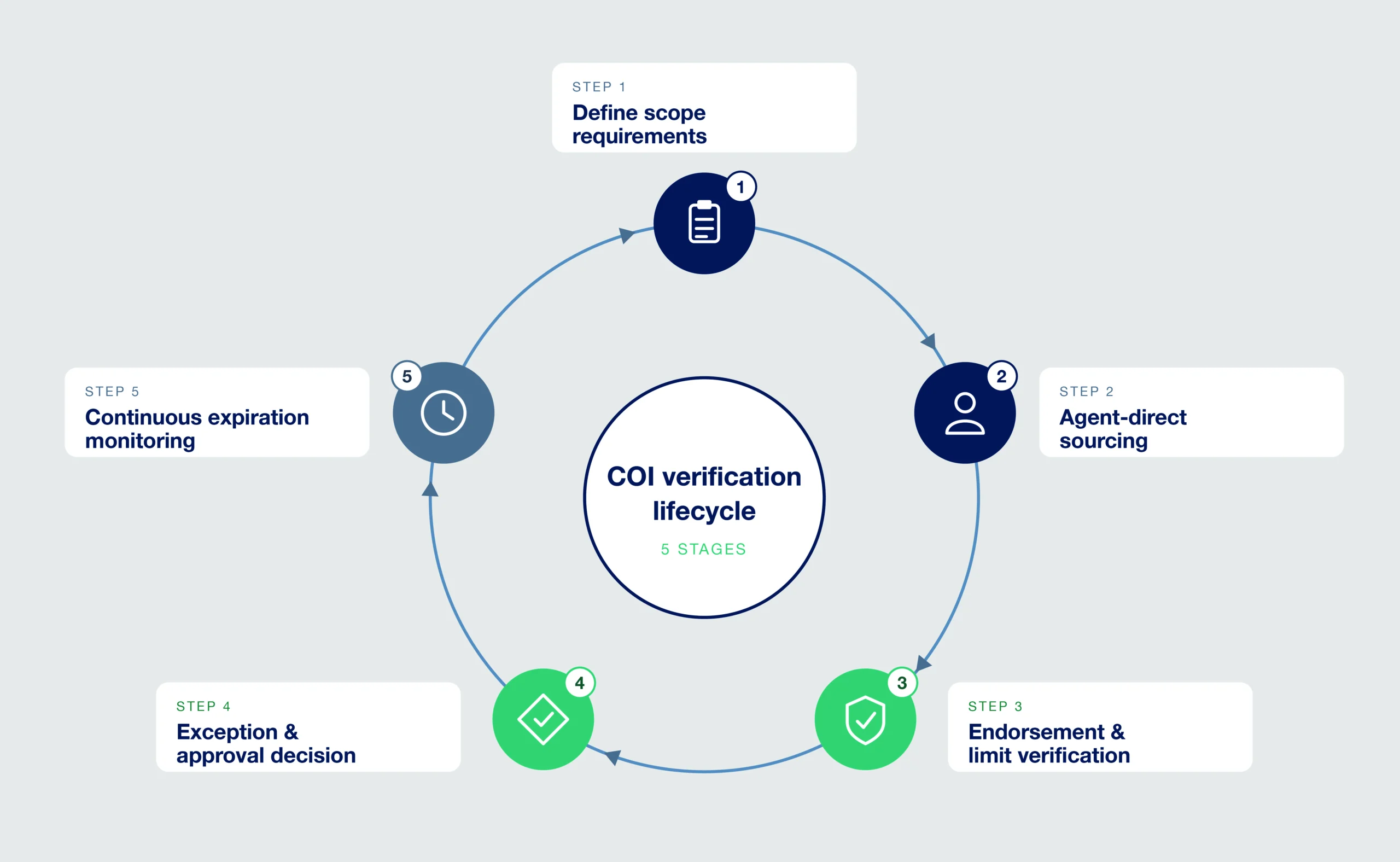
A sound process connects insurance specifications to the work scope, obtains COIs from the issuing agent or broker, reviews the evidence against those specifications, and follows up when policies renew or the work changes. Agent sourcing reduces the opportunity for a contractor to alter a PDF before submission. It does not remove the need for review: a certificate summarizes reported policy information, while the policy and its endorsements determine coverage.
Start with the work, then set the requirement
An electrical contractor, a professional engineering firm, and a vendor making occasional deliveries do not present identical exposures. Insurance requirements should reflect the services, location, project value, use of vehicles, subcontracting arrangements, and potential consequences of a loss. Risk management, procurement, and legal teams should establish the standards before a contractor is asked to comply with them.
The written contract should identify the required coverage types, limits, parties to be insured, endorsements, and period for which coverage must be maintained. It should also state when proof is due and who can approve an exception. A general request for “current insurance” leaves too much room for interpretation.
For example, a contractor designing a facility’s control system may need professional liability coverage for its design services, while an electrical contractor installing that system presents different on-site and vehicle exposures. Both may need general liability coverage, but the complete insurance requirements should follow their respective contracts and work scopes. Assigning the same insurance schedule to both can create unnecessary requests and still overlook a relevant exposure.
Common types of contractor insurance
| Coverage | Why it may be required |
|---|---|
| Commercial general liability (CGL) | Addresses covered third-party bodily injury, property damage, and other specified liability arising from operations. |
| Workers’ compensation and employers’ liability | Addresses employee work injuries and related employer liability, subject to applicable law and policy terms. Requirements vary by jurisdiction and workforce arrangement. |
| Commercial automobile liability | Addresses covered liability from vehicles used in the work. The requirement may need to address owned, hired, or non-owned autos. |
| Umbrella or excess liability | Adds limits above specified underlying policies, subject to the excess policy’s terms. |
| Professional liability, pollution liability, or cyber coverage | May be appropriate when the scope involves design or advice, environmental exposures, or access to sensitive systems and data. |

These are categories, not a universal insurance schedule. A commercial general liability policy does not automatically cover professional errors, pollution, or every other exposure a contractor may create. Nor does an umbrella policy necessarily sit over every primary policy. The insurance specification should be tailored with the organization’s broker and counsel where the exposure warrants it. The Insurance Information Institute explains common CGL exclusions and excess coverage.
Understand what additional insured status requires
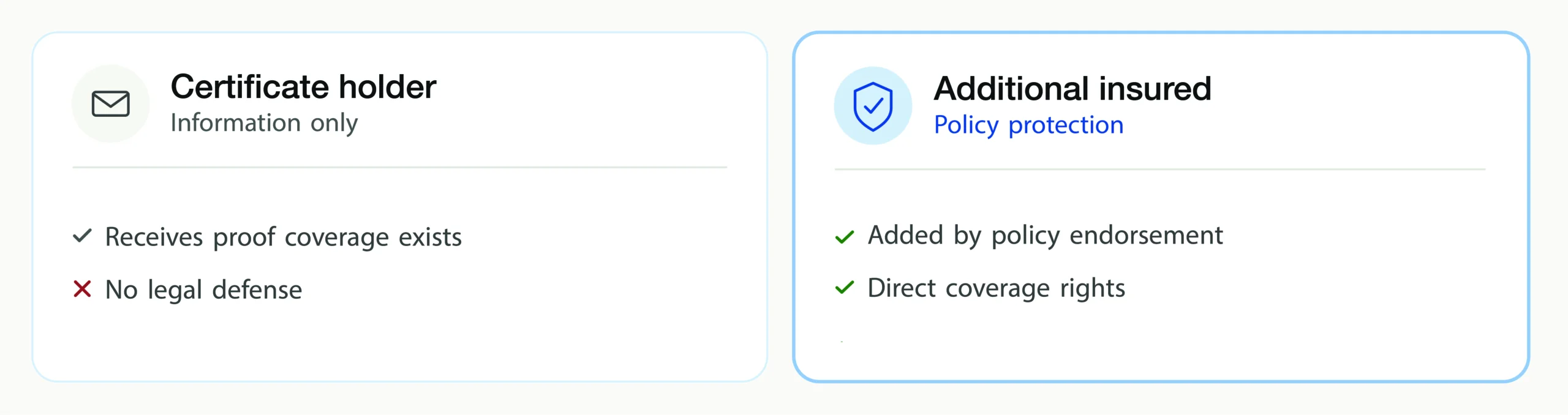
Many contracts require the hiring organization, project owner, or general contractor to be included as an additional insured on a contractor’s liability policy for specified operations. That status is different from being listed as the certificate holder, which identifies the party receiving the COI.
If additional insured status is required, check the applicable policy provision or endorsement and whether it addresses the party, work, and period contemplated by the contract. A blanket endorsement may apply only when its conditions are met, such as a written contract. Completed operations, primary and noncontributory wording, and a waiver of subrogation are separate requirements when the contract calls for them. They should not be assumed from a checked box or a sentence in the certificate’s description field.
The ACORD 25 certificate form published by the New York Department of Financial Services expressly distinguishes certificate holder status from additional insured rights and notes that the certificate does not change the underlying coverage. The practical rule is straightforward: when an endorsement matters to the contract, obtain and review the relevant endorsement rather than relying on the COI alone.
Review the COI against the contract
A COI is a useful starting point because it presents the named insured, insurers, policy numbers, coverage lines, limits, and policy dates in one place. It is not an approval by itself. Compare what it reports with the actual insurance requirements for that contractor and project.
The source of the certificate matters, too. A contractor-submitted PDF can be edited before it reaches the hiring organization, making a document appear to show the required limits or coverage. A direct agent or broker response offers a more reliable chain of custody, but reviewers still need to examine the reported coverage, required endorsements, and policy terms.
Review the following before marking the insurance requirement complete:
- Identity: Does the named insured correspond to the legal entity performing the work? Is the certificate holder correctly identified?
- Coverage and limits: Are every required line and limit shown, including applicable per-occurrence and aggregate limits? If excess limits are needed, are the relevant underlying coverages identified?
- Dates: Are the policies effective before mobilization, and when does each line expire? Different policies on the same COI can have different dates.
- Contract terms: Are required additional insured provisions and other endorsements supported by the actual policy language or endorsement documents?
- Work scope: Do the reported coverages align with the contractor’s activities, location, and subcontractor use? Refer questions about exclusions or policy interpretation to the broker, insurer, or legal team.
When information is missing or inconsistent, return a specific deficiency to the contractor or broker. “Insurance rejected” is less useful than “the auto liability line is missing” or “please provide the additional insured endorsement required by the agreement.” A clear response reduces unnecessary resubmissions and keeps the review consistent.
Track expirations throughout the work
Contractor insurance requirements do not end when a contractor is approved. Policies can expire during a project, and a new COI may reflect different limits, insurers, or endorsements. Keep each policy’s expiration date and the contractor’s active assignments in one record. Send renewal requests before expiration, review the replacement evidence against the same requirements, and alert the responsible team when a gap remains unresolved.
An effective renewal process answers three operational questions: Which contractors have coverage coming due? Which are still performing work? Who decides whether work can proceed if the required evidence is missing? That decision belongs to the hiring organization under its own policy and contract, with any exception documented and time limited.
Renewal dates are only one trigger. Reassess requirements when a contractor’s scope expands, the project moves to another jurisdiction, a new subcontractor is added, or a contract changes. A COI issued at onboarding is a snapshot of reported information at that time; it should not be treated as a guarantee that coverage remains unchanged.
Listing an organization as the certificate holder is not, by itself, a promise of 30 days’ advance notice of cancellation. The current ACORD 25 form says cancellation notices are delivered according to the policy provisions. A process that relies on a certificate and waits for a cancellation notice can therefore leave a gap.
CanQualify addresses that gap through InsureQual’s integrated AI insurance capabilities, powered by Certificial. CanQualify obtains COIs directly from agents or brokers, while AI-assisted processing helps organize the certificate information for validation against each client’s requirements. When an agent’s system is connected, InsureQual can also alert the client to reported policy changes, including cancellations and reduced limits, without waiting for the next renewal or relying solely on a cancellation notice. For an agent outside the connected network, the COI remains a static document, and updated evidence must be requested and reviewed. These capabilities improve visibility; they do not change the policy’s coverage or its notice terms.

Common gaps that create avoidable exposure
The most frequent problems are usually process failures rather than obscure insurance language:
- Collection without review: A certificate is stored without comparison to the contract’s coverage types, limits, and endorsements.
- Uncontrolled document source: An editable PDF is accepted from the contractor without obtaining the certificate from the issuing agent or broker.
- Certificate holder confusion: The client is named as certificate holder and assumed to be an additional insured.
- Uniform requirements for every supplier: Low-exposure vendors face unnecessary demands while specialized work lacks appropriate coverage.
- Untracked renewals: A policy expires after onboarding, but the contractor remains active with no review of replacement evidence.
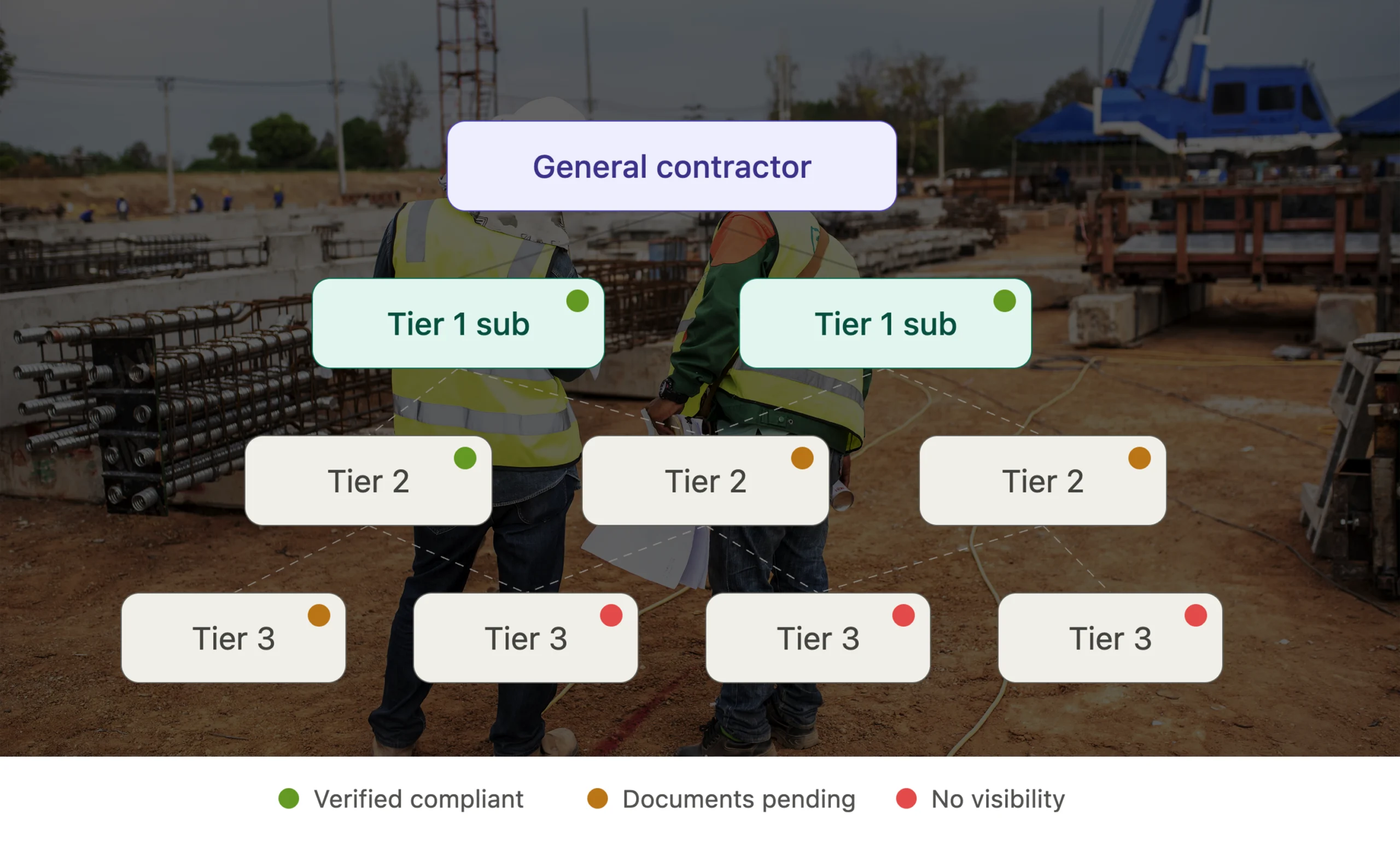
- Disconnected subcontractor records: The prime contractor is reviewed, while firms actually performing part of the work are not visible in the program.
- Informal exceptions: Work starts despite a deficiency, without an authorized decision, rationale, owner, or deadline.
The remedy is a defined review standard and a process for correcting gaps before work begins and while it continues. Where requirements cannot be met, the exception should be evaluated by the organization’s designated risk owner rather than silently converted into approval.
Make insurance part of contractor compliance
Insurance review works best when it is connected to prequalification and mobilization. The hiring organization defines requirements by scope; the contractor identifies its agent or broker; insurance evidence is obtained from that source and validated against the standard; and unresolved deficiencies remain visible to those making the work decision. Ongoing monitoring then addresses renewals and available policy changes after the initial review.
This is the role of insurance monitoring within the broader contractor compliance program. InsureQual connects insurance review and monitoring to the prequalification workflow so deficiencies remain visible when work decisions are made. The client remains responsible for setting its standards and making risk acceptance decisions.
The goal is a reliable answer before and during the job: Does this contractor’s documented insurance meet the requirements for this work right now, and who is addressing any gap?
Frequently Asked Questions About Contractor Insurance & COIs
How do you handle a contractor who starts work before insurance prequalification is complete?
Organizations should establish a formal variance/exception process owned by a designated risk officer rather than allowing field teams to grant silent approvals. Exceptions should be documented with a fixed expiration date and restricted to low-risk scopes.
What is the difference between an Additional Insured Endorsement and a Certificate Holder on a COI?
Listing a company as a Certificate Holder simply acknowledges that the document was sent to them. An Additional Insured Endorsement is an actual policy amendment that extends coverage to the hiring organization for claims arising out of the contractor’s work.
Why is accepting an unverified PDF COI directly from a contractor a risk?
PDF certificates provided directly by contractors can be easily edited or alter critical details such as coverage limits, policy dates, or additional insured status. Validating directly through the issuing broker or agent establishes an authentic chain of custody.
How should contractor insurance requirements change based on project scope?
Requirements should match exposure levels. High-risk or specialized work (e.g., environmental, design, cyber-adjacent) requires dedicated policies like Professional Liability or Pollution Liability, whereas standard delivery vendors require lower thresholds.
What happens when a contractor’s insurance policy expires mid-project?
COIs represent policy status only at the time of issuance. An effective compliance system tracks renewal dates automatically, issues advance notice prior to expiration, and flags active contractors whose coverage drops or lapses during active work.
Streamline Contractor COI Verification & Renewal Tracking
Eliminate manual document reviews and reduce coverage gap risks with automated agent verification and continuous monitoring.