What to Do After a Contractor Fails a Qualification or Safety Requirement
Contractor prequalification is often treated as a gate: a contractor either meets the requirements or does not.
That approach is simple, but it can also be too rigid.
A mature contractor safety program does more than approve or reject contractors. It identifies deficiencies, communicates expectations, tracks corrective action, and uses that information to improve future qualification decisions.
The objective is not to lower standards. It is to create a process that distinguishes between an unacceptable risk and a correctable deficiency, then applies a consistent response based on the level of risk.
What is contractor corrective action?
Contractor corrective action is the structured process of identifying a contractor related deficiency, determining the appropriate response, documenting what must be corrected, validating the issue has been resolved, and using that history in future qualification decisions.
Approval Should Not Be the End of the Process
Contractor qualification is a point-in-time decision based on the information available at that moment. That information can change.
Safety performance may decline. Insurance can expire. Training can lapse. A contractor may begin performing a different scope of work. An audit may identify weaknesses in a written program or reveal that a documented procedure is not consistently followed in the field.
A contractor that was acceptable six months ago may require additional review today. That is why contractor prequalification should be connected to ongoing monitoring, corrective action, and requalification rather than treated as a one-time administrative event.
How Do You Continuously Monitor Contractor Compliance?
Continuous contractor compliance monitoring means watching for changes that can affect a contractor’s qualification status after the initial review. Depending on the work and the hiring organization’s requirements, that may include expiring insurance, changes in safety performance, training or credential expirations, unresolved corrective actions, new audit findings, changes in work scope, or open exceptions.
Monitoring should also make emerging issues visible to the people responsible for contractor oversight. Automated alerts can help identify expirations, missing requirements, unresolved corrective actions, and other changes that may require review, but the alert itself is only the starting point.
When a change creates a deficiency, the organization still needs a consistent process for evaluating its significance, determining what must be corrected, and deciding whether the contractor can continue working while the issue is resolved. In that sense, continuous monitoring and corrective action are part of the same contractor-management process.
Not Every Deficiency Should Produce the Same Response
One of the more difficult parts of contractor management is deciding what to do when a contractor does not fully meet a requirement. The response should reflect the nature of the deficiency, the work being performed, and the level of risk.
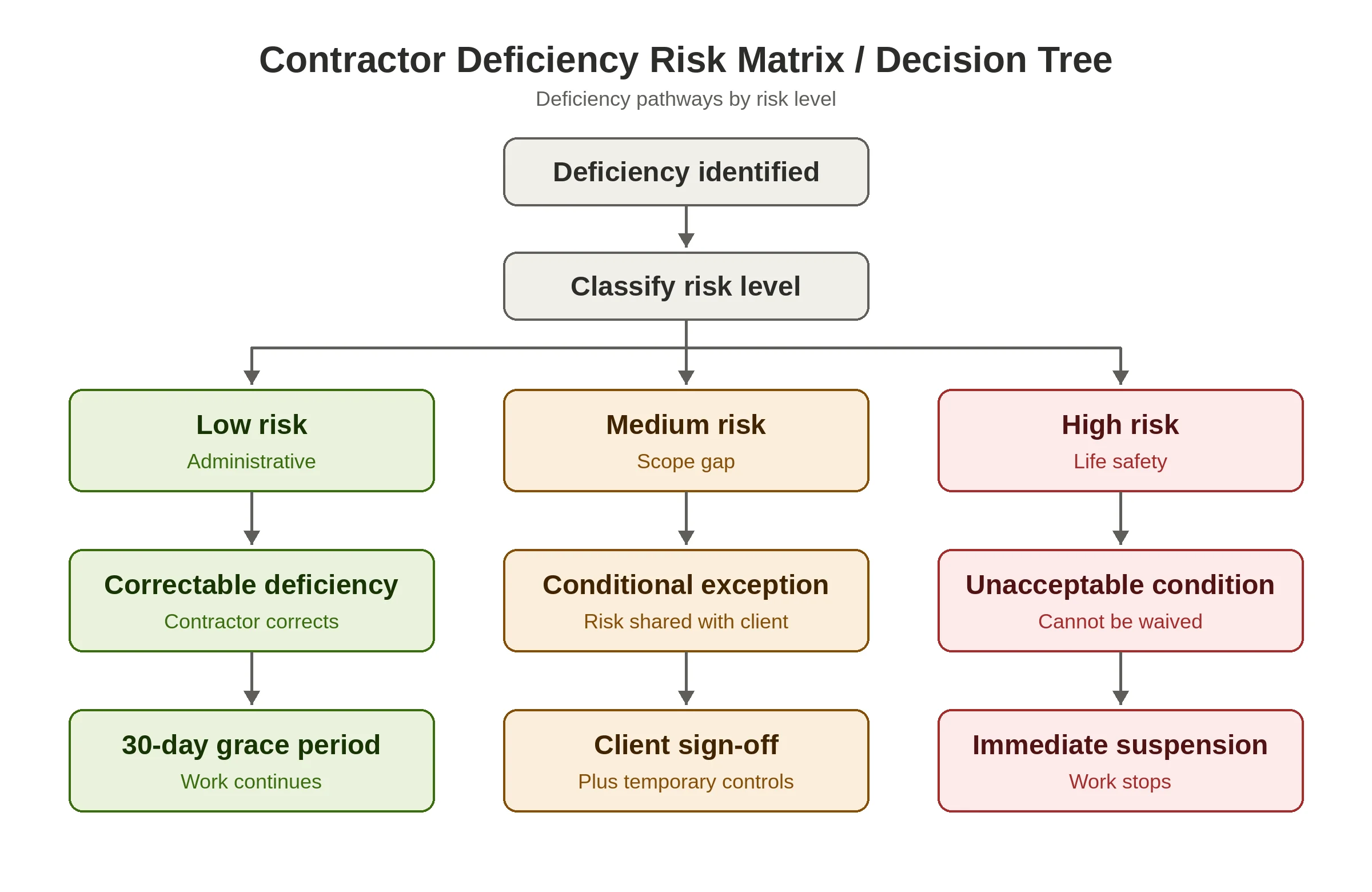
Correctable deficiency
The requirement is not met, but the issue can reasonably be corrected without exposing workers or operations to unacceptable risk.
- An expired document that can be replaced
- Missing training documentation
- Incomplete safety-performance information
- A recurring administrative issue that has not yet become a significant safety concern
Conditional or exception-based review
The contractor does not fully meet a benchmark or requirement, but additional documentation, corrective action, temporary controls, or client approval may allow the work to proceed under defined conditions.
- Safety performance outside a client benchmark
- A written safety program that does not fully address the assigned scope of work
- A qualification gap that may be mitigated through defined temporary controls
Unacceptable condition
The deficiency creates a level of risk that should prevent approval or continued work until the issue is corrected.
- Inability to demonstrate competence for high-risk work
- A material regulatory issue
- An unresolved critical audit finding
- A missing requirement directly tied to safe execution of the assigned work
The important distinction is whether the deficiency can be corrected within an established process or whether it represents an unacceptable condition. A mature program defines that distinction before the issue occurs.
For example, an expired certificate of insurance and missing evidence of task-specific hot-work training are both deficiencies, but they do not present the same type of risk. The insurance issue may require administrative correction or restriction under the hiring organization’s requirements. Where task-specific training or authorization is required, missing evidence that a worker is qualified for hot work can require the work to stop until competence and authorization are established. The response should follow the nature of the requirement, the work scope, and the potential consequence of proceeding without correction.
Corrective Action Requires More Than an Email
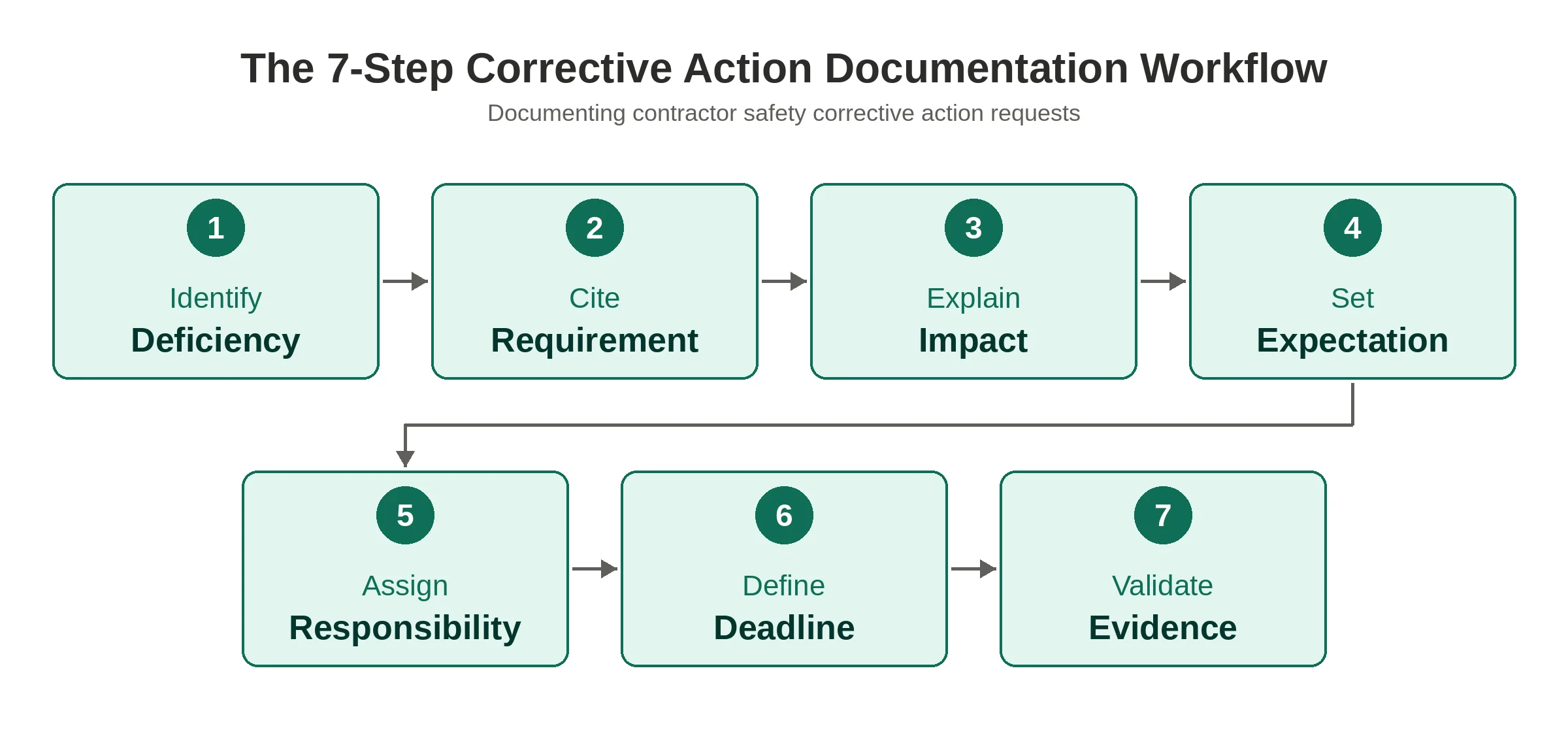
Corrective action should be documented and managed consistently. When a deficiency is identified, the organization should be able to answer several basic questions:
- What is deficient?
- What requirement applies?
- Why does the requirement matter?
- What corrective action is expected?
- Who is responsible for completing it?
- When must it be resolved?
- What evidence will demonstrate that the issue has been corrected?
Without that structure, corrective action can quickly become a series of emails, phone calls, spreadsheets, and undocumented exceptions. The contractor may not clearly understand what is required, and the hiring organization may have difficulty demonstrating why the contractor was ultimately approved, restricted, suspended, or allowed to continue working.
A documented corrective-action process creates a clearer record for both sides.
Corrective Action Is Not the Same as an Exception
A contractor may sometimes be permitted to proceed despite an unresolved qualification issue, but that decision should be deliberate, documented, time-limited, and approved by the appropriate party. An exception should not become a substitute for correcting the deficiency.
A defensible exception process should identify:
- The requirement that is not met
- Why the exception is being considered
- Any temporary controls or restrictions
- Who approved the exception
- How long the exception is valid
- What corrective action is still required
- What happens if the deficiency is not resolved
This keeps exceptions visible and prevents temporary decisions from quietly becoming permanent workarounds.
A similar distinction can arise when a contractor falls outside a client’s safety-performance benchmark. Rather than treating the result as an automatic approval or rejection, the organization may require additional documentation, a written improvement plan, temporary controls, or formal exception review. The final decision still belongs to the hiring organization and should reflect the level of risk and the requirements it has established.
Contractor Corrective Action Should Be Risk-Based
Corrective action should reflect the risk associated with the deficiency. A missing administrative document should not necessarily receive the same response as an unresolved safety issue involving high-risk work. Likewise, schedule pressure or project urgency should not override established safety requirements.
A practical contractor corrective-action process may consider:
- Severity of the deficiency
- Work scope and exposure
- Potential consequences
- Regulatory requirements
- Contractor safety history
- Whether the deficiency is isolated or recurring
- Whether temporary controls can reasonably reduce the risk
- The contractor’s responsiveness to previous corrective actions
This allows safety teams to maintain clear standards while still exercising appropriate professional judgment.
Who Owns the Decision?
Corrective action works best when decision authority is clear. In larger organizations, several functions may influence the outcome, but they do not necessarily own the same part of the process.
- Safety may establish risk expectations and evaluate the significance of a deficiency.
- Procurement or operations may manage the commercial relationship and onboarding process.
- Site leadership may identify operational constraints or urgency.
- The contractor owns completion of the corrective action.
- The hiring organization or client retains final authority over approval, restrictions, exceptions, suspension, or disqualification.
Clear governance helps prevent inconsistent decisions between sites, projects, or departments and makes escalation more defensible.
Corrective Action and Contractor Requalification Should Be Connected
Corrective action becomes more valuable when it influences future qualification decisions. If a contractor repeatedly submits expired documentation, misses training requirements, receives similar audit findings, or fails to close corrective actions on time, those patterns should not disappear when the annual qualification cycle resets.
Requalification should consider more than the contractor’s current documents. It should also consider the contractor’s history, including:
- Prior deficiencies
- Corrective-action completion
- Recurring audit findings
- Changes in safety performance
- Incident history
- Training or credential issues
- Responsiveness to compliance requirements
- Changes in work scope or risk exposure
A contractor that consistently addresses deficiencies quickly and thoroughly presents a different risk profile than one that repeatedly requires escalation. That information can improve future decisions.
Recurring Deficiencies May Reveal a Program Problem
Corrective-action data is not only useful for evaluating individual contractors. It can also identify weaknesses in the hiring organization’s own contractor management process.
Recurring issues can also be a sign of broader reasons contractor compliance programs fail.
If the same deficiency appears across many contractors, the issue may no longer be only a contractor problem. It may indicate unclear requirements, inconsistent enforcement, poor onboarding, or a qualification criterion that is not aligned with the actual work.
The organization may need to ask:
- Are the requirements clearly communicated?
- Are they being applied consistently?
- Are they relevant to the work being performed?
- Are different locations interpreting the requirement differently?
- Are contractors being given enough information before onboarding begins?
- Is the requirement creating administrative work without reducing meaningful risk?
A mature contractor safety program should be willing to improve its own processes, not simply demand improvement from contractors.
Audits Make Corrective Action More Meaningful
Document review can identify whether a contractor has submitted required information. Audits can go further.
A safety manual audit may identify gaps between the contractor’s written programs and the work being performed. An implementation audit may reveal whether those programs are actually being followed in practice. Field or regulatory-readiness audits can identify additional deficiencies that would not necessarily appear during basic prequalification.
The value of an audit is not simply the finding. The greater value comes from what happens next.
A useful audit process should support:
- Identification of the deficiency
- Documentation of the finding
- Communication with the contractor
- Corrective-action requirements
- Evidence of resolution
- Follow-up when necessary
- Use of the finding in future qualification and risk decisions
That turns an audit from a snapshot into part of an ongoing contractor improvement process.
Continual Improvement Requires Data
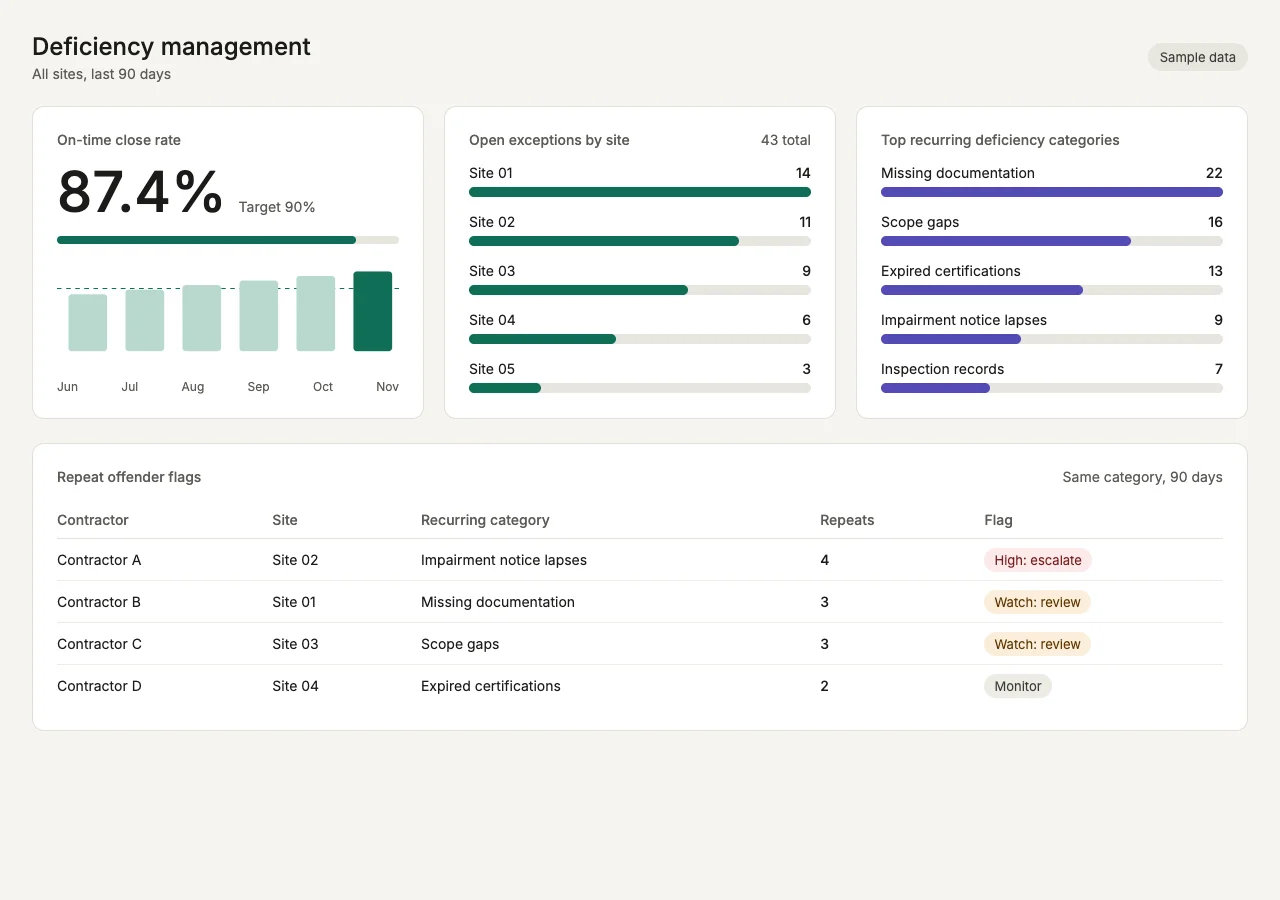
Contractor management programs generate a significant amount of information. The challenge is using it.
Leadership and safety teams should be able to identify both patterns and measurable indicators, such as:
- Percentage of corrective actions closed on time
- Average days to resolution
- Most common deficiency categories
- Repeat deficiencies by contractor
- Repeat deficiencies by location
- Number of active exceptions
- Corrective actions reopened after closure
- Contractors requiring escalation during requalification
- Changes in contractor safety performance over time
These trends can help organizations refine qualification requirements, improve contractor communication, adjust risk categories, strengthen audits, and focus internal resources where they are most needed. That is where contractor data becomes more than documentation. It becomes a management tool.
How Corrective Action Supports ISO 45001 Continual Improvement
Corrective action also fits within the broader continual-improvement model reflected in ISO 45001. Clause 10.2, Incident, Nonconformity and Corrective Action, addresses how an organization responds to nonconformities, corrects them, evaluates causes, and takes action intended to prevent recurrence. For contractor management, that makes documented deficiencies, evidence of resolution, recurring findings, and follow-up relevant inputs to a broader OH&S management system.
Contractor controls also connect upstream to ISO 45001 Clause 8.1.4 on procurement, including the contractor-specific requirements in Clause 8.1.4.2. Those provisions address the coordination of procurement processes with contractors and the identification and control of OH&S risks associated with contractor activities. A structured corrective-action process can support those controls when contractor activities are within the organization’s OH&S scope.
This does not mean every contractor deficiency is an ISO 45001 nonconformity or that every contractor corrective action is required by the standard. The value of the connection is narrower: when contractor activities affect the OH&S management system, a consistent process for identifying, correcting, documenting, and learning from deficiencies can support the organization’s larger management-system objectives.
A Better Contractor Safety Program Creates a Path to Improvement
A mature contractor program does not lower standards when a deficiency is identified. It applies the right response to the level of risk.
Some deficiencies can be corrected. Others may require an exception, additional controls, escalation, suspension, or disqualification.
The important part is having a consistent process that documents the issue, defines the response, validates resolution, and uses that history in future qualification decisions.
That is how corrective action becomes more than a compliance task. It becomes part of a stronger contractor risk-management process.
Build a More Consistent Contractor Compliance Process
See how CanQualify can support contractor qualification, monitoring, corrective action, and requalification.